|
Getting your Trinity Audio player ready...
|
Sophia Shkuro:
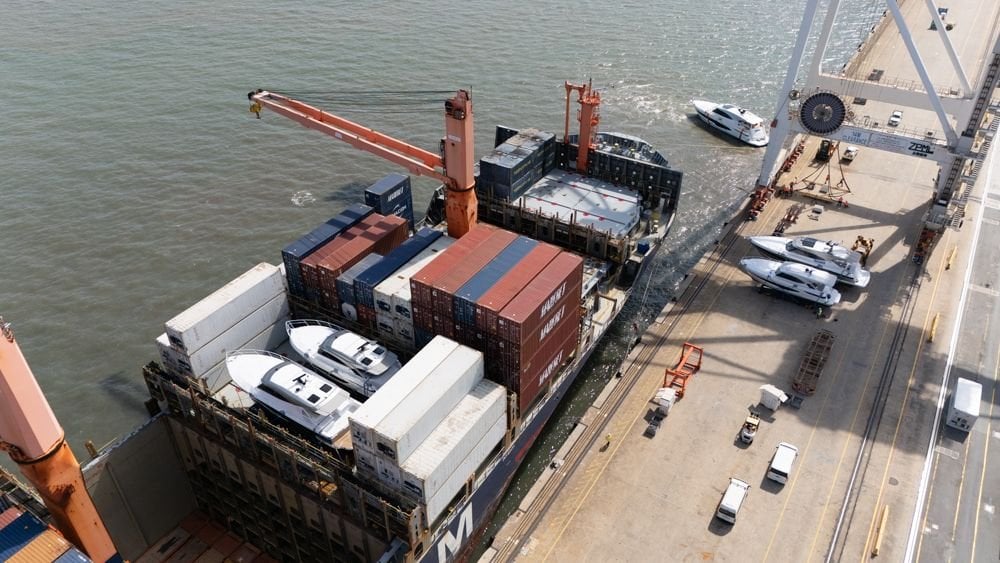
Is it possible to manage project cargo at a container terminal and ship it by container vessel without disrupting schedules or causing operational complications? The Port of Brisbane proves that this is possible, as 15 yachts were loaded from the quay and from the water onto the CMA CGM Abu Dhabi vessel, while containers continued to move.
There was no panic caused by uncertainty, but rather a consistent plan: deck planning that ensures the ship’s stability, lift control, a sequence that does not interfere with container operations, and marine fastenings that leave no room for swaying.
Consolidating such high-value cargo on a regular service line can beat the Ro-Ro/HL price and offer shorter transit time. So, let’s break down this case step by step.
The Myth we’re busting
“Project cargo and container terminals don’t mix.”
So, how were 15 motor yachts transported without causing bottlenecks in traffic areas? The answer is planning. This operation is a prime example of careful management, from fencing off the project area on deck and limiting crane operating times to controlling hybrid lifts (from the pier and water). Don’t rely solely on improvisation. Then this myth will have no bearing on your logistics.
Safety in this area was strict. Surveys were also conducted with verified lifting points, jointly developed fastenings, and appropriate fastenings.
Case snapshot: one container ship, 15 yachts
Wasn’t a routine call.
CMA CGM Abu Dhabi, a > 15,000-TEU ship (about 366 m long and 51 m wide), took on an unusual deck mix while box work continued nearby. Namely, 15 recreational yachts were loaded in a single call at the Port of Brisbane, Australia.
The operation combined two methods: yachts were lifted from the quay and directly from floating units alongside, a hybrid setup that shortened the turnaround and kept risk under control.

Image source: USM Media
What made it unique?
It was the largest single shipment of yachts ever transported on a container vessel.
Parallel handling of standard containers and a breakbulk deck of yachts, with lifts from shore and from the water executed inside tight weather/tide windows.
Stakeholders.
The carrier CMA CGM, Port of Brisbane/terminal teams, and specialized crane operators are coordinating a dedicated project workflow on deck.
How do you load yachts on a container ship?
Let’s dive into planning this operation and break down each step of its preparation, which you can implement in your processes step-by-step:
1) Plan your work in advance
The first focus is on the deck and stability. It is necessary to determine exactly where each yacht will be located and the order of their arrival. Next, check the basic parameters: weight, center of gravity, how much wind each hull “catches,” and the limits of the vessel’s stability. Anything that could take the vessel outside the safe zone will lead to a revision of the plan without touching the slings.
2) Deck preparation
Provide the yachts with a proper “parking space” for loading. Define a clear project area, install cradles or steel beds for each hull, and lay down mats for possible contact between metal and paint.

3) Select the best rigging equipment and gear
Measure twice, lift once. Check the crane’s radius and lifting capacity, select slings and spreaders that match each yacht’s lifting points, and soften the straps so they don’t cut into the gelcoat.
4) Run hybrid lifts (two ways to get on deck)
- From the quay: roll up on low-loaders, hook on, and lift straight into the prepared cradle
- From the water: bring the yacht alongside, fit the slings, and lift cleanly out of the water during approved weather/tide windows

5) Plan the loading sequence on the deck
Determine the time frame for crane operation and coordinate the lifting order with container movement so that none of them stand idle longer than necessary.
6) Fastening and lashing for maritime transport
After securing the yacht to the fastening, it is fixed in place to prevent micro-movements using wedges, supports, chains in the designated areas, and, if necessary, welded fastenings on the deck.
7) Finalizing paperwork
Before departure, organize the following: preliminary inspections, photographs of the condition, updates to the cargo plan, insurance confirmations, and all the shipping documents. If any questions arise during your stay at your destination, these documents will help answer them long before they become problems.
Container ship vs. heavy-lift or Ro-Ro?
| Factor | Container Ship | Heavy-Lift (MPP/HL) | Ro-Ro |
| Frequency | High, fixed rotations | Irregular/spot | Medium, route-dependent |
| Transit reliability | Predictable ETAs | Variable | Good, limited ports |
| Cost per unit | Strong with consolidation | Strong for single OOG | Good if drivable |
| Deck/height limits | Needs planning | Flexible | Ramp/height limits |
| Best for | Batches (e.g., 15 yachts), show seasons | Very heavy/oversize | Rolling cargo, minimal rigging |
When comparing total shipping cost, pull live and compare freight rates or submit a shipping quote request for the specific scope (origin/port/handling). For digital add-ons (real-time tracking, visibility, and supply chain analytics), you can request an IT quote.
Safety and risk control for high-value cargo
1) Do not ignore weather conditions and do not make “one more” attempt. This can be a very costly mistake when moving hulls worth millions of dollars. If conditions deteriorate, lifting and loading must be stopped.
2) Protect the hull, not the schedule. When loading cargo, time is not more important than safety. Attach slings and spreaders to these points; pad areas where straps contact gelcoat; then do a quick “pre-tension” test before taking on the full weight. Lift it suddenly, and if you hear a squeak or shift, stop and start over.
3) 100% safety. Fastening on the ship: pads, supports, chain fastenings at specially designed fastening points; welded marine fastenings where necessary. Re-check after the next lift and again before departure.
4) Insurance and inspections. Before loading, inspections are carried out with photography (hull, supports, drives, electronics). Certificates and signatures of lifting equipment are recorded. Any special conditions (such as weather windows or handling restrictions) are noted. Everything that is recorded on paper can be used as evidence.
To top it off, ask yourself a few questions to check:
- Weather within limits? ✔️
- Lift points verified against OEM data? ✔️
- Exclusion zone active and staffed? ✔️
- Lashing/sea-fastening inspected and logged? ✔️
- Survey pack complete (photos + certificates)? ✔️
Conclusion
As a result, expensive hulls and project cargoes can be transported on regular container ships without disrupting the shipping schedule, as there is no need to wait for a unique slot for heavy cargoes.
Consolidating high-value cargo on a regular service line can offer a better price than Ro-Ro/HL and shorter transit times. To achieve this, it is necessary to follow the successful strategy of CMA CGM Abu Dhabi in Brisbane.