|
Getting your Trinity Audio player ready...
|
On Monday afternoon, President Donald Trump escalated pressure on the Islamic Republic of Iran with an announcement that immediately reverberated across global markets and diplomatic circles. In a statement posted publicly, the president declared that the United States would impose a sweeping 25 percent tariff on any country that conducts business with Iran, a move framed as both “final and conclusive.” While the stated target of the policy is Tehran, the broader implications extend far beyond Iran itself—most notably to China, America’s largest trading partner and Iran’s most significant economic lifeline.
According to Trump’s declaration, any nation maintaining commercial ties with Iran would face a blanket 25 percent tariff on all trade conducted with the United States. The scope of the announcement is unusually broad, raising immediate questions about feasibility, enforcement, and legality. If implemented in full, the policy would represent one of the most expansive uses of trade penalties in modern U.S. history, effectively weaponizing access to the American market as leverage against third-party countries.
At the center of the potential fallout is China. By a wide margin, Beijing is Iran’s largest trading partner, accounting for roughly 30 percent of all Iranian trade. Even more critically, China is the destination for an estimated 80 percent or more of Iran’s oil exports, providing Tehran with a crucial revenue stream amid years of sanctions and diplomatic isolation. Under the logic of Trump’s announcement, these ties would automatically trigger a 25 percent tariff on all Chinese goods entering the United States—across the board.

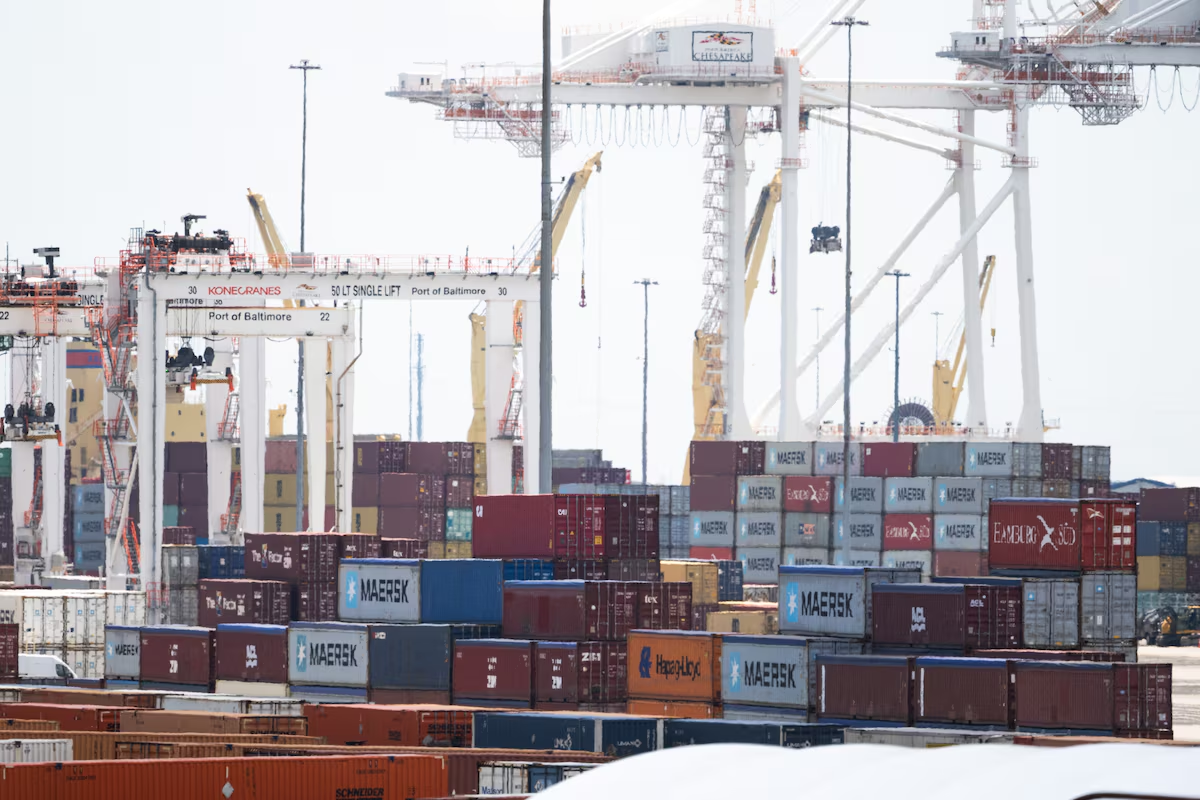
Such a move would instantly reignite tensions between Washington and Beijing, reopening a trade war that had only recently cooled. The transpacific trade lane linking China and the United States is the largest and most economically significant in the world, underpinning global supply chains for consumer goods, industrial components, and advanced technologies. A new tariff regime of this magnitude would compress profit margins for Chinese manufacturers, raise costs for American retailers, and ultimately be felt most sharply by U.S. consumers through higher prices and reduced availability.
China, however, is not the only country implicated. Turkey and the United Arab Emirates rank next among Iran’s trading partners, each responsible for less than 10 percent of Iran’s total trade. Both nations maintain close strategic relationships with the United States, particularly in security and regional diplomacy. A policy that penalizes them for commercial engagement with Iran would place Washington in the uncomfortable position of sanctioning its own allies, potentially straining already delicate regional relationships.
Supporters of the announcement argue that its sheer scale is precisely the point. By threatening to cut off access to the U.S. market, the administration aims to isolate Iran economically, forcing its leadership to the negotiating table or constraining its ability to fund regional activities that Washington views as destabilizing. In this view, secondary tariffs serve as a blunt but effective tool to close loopholes that have allowed Iran to continue trading despite years of sanctions.
Critics, however, warn that the strategy risks collateral damage on a massive scale. The last major trade confrontation between the United States and China offers a cautionary tale. During the previous round of tariffs, U.S. industries experienced significant disruptions, including serious supply shortages for defense contractors. These shortages were tied directly to China’s dominance in the production and processing of rare earth elements and specialized magnets—materials essential for advanced weapons systems, electronics, and renewable energy technologies.
That episode reached a turning point in October 2025, when Beijing sharply restricted exports of rare earth elements and magnets. The move threatened the ability of U.S. defense companies to meet production targets for advanced weapons platforms, prompting alarm within the Pentagon and across Congress. Facing the prospect of long-term strategic vulnerability, the White House ultimately stepped back from its hardline trade posture.
To restore access to these critical minerals, the administration suspended a proposed plan to levy port call fees on Chinese-built and Chinese-owned vessels entering U.S. ports. The reversal was widely interpreted as an effort to assuage Beijing’s concerns and stabilize the flow of strategic materials. Chinese exports of rare earths soon resumed, underscoring the degree of leverage Beijing holds in key sectors of the global economy.
Against this backdrop, Trump’s new tariff threat raises questions about whether the administration is prepared for a similar escalation—and whether it has sufficient leverage to prevail. China’s economic relationship with Iran is not merely transactional; it is also strategic, tied to Beijing’s broader energy security goals and its long-term infrastructure investments across the Middle East. Asking China to sever these ties would represent a significant demand, one that Beijing may resist through economic or diplomatic countermeasures.
The announcement also lands at a moment of legal uncertainty. The president’s authority to impose emergency tariffs is currently under review by the U.S. Supreme Court, with a ruling expected on Wednesday. At issue is whether the executive branch possesses broad, unilateral power to set import levies, or whether such authority rests primarily with Congress under the Constitution.

Trump Weighs 25% Tariff on Chinese Imports to Pressure Iran
If the court determines that the president lacks sweeping powers to impose tariffs on specific countries, the administration’s options would narrow considerably. Trump could still rely on delegated authorities granted by Congress to impose tariffs on certain categories of goods, particularly those deemed critical to national security. However, these measures would apply by commodity type rather than by country of origin, limiting their effectiveness as a tool of geopolitical pressure.
Legal scholars note that even a favorable ruling for the administration would not eliminate practical challenges. Enforcing a tariff regime based on third-party trade with Iran would require unprecedented levels of monitoring and verification. Determining whether a product entering the United States originates from a country that conducts business with Iran—and to what extent—would add layers of complexity to customs enforcement and invite disputes, exemptions, and potential evasion.
From a market perspective, the uncertainty alone is enough to unsettle investors and supply chain planners. Shipping companies, insurers, and port operators would need to reassess risk across key routes, particularly in the transpacific corridor. Any hint of renewed trade warfare could prompt companies to accelerate diversification efforts, shifting production to Southeast Asia, Mexico, or other regions less exposed to U.S.-China tensions.
For Iran, the immediate impact of the announcement is less clear. While the threat is designed to further isolate Tehran, Iran has demonstrated resilience under sanctions by deepening ties with non-Western partners and expanding informal trade networks. Whether secondary tariffs can meaningfully constrain Iran’s economy without provoking broader global disruption remains an open question.
Ultimately, Trump’s declaration represents a familiar pattern in his approach to foreign policy and trade: maximum pressure, delivered through bold and uncompromising language, intended to force rapid concessions. Whether this strategy can succeed in a far more interconnected and legally constrained global economy is uncertain.
Trump Weighs 25% Tariff on Chinese Imports to Pressure Iran
As governments, businesses, and courts weigh the implications, one fact is already evident. A policy aimed at Iran has the potential to reshape trade relations among the world’s largest economies, revive dormant conflicts, and test the limits of presidential power. In seeking to apply pressure on a single adversary, the United States may once again find itself confronting the complex realities—and unintended consequences—of global economic interdependence.