|
Getting your Trinity Audio player ready...
|
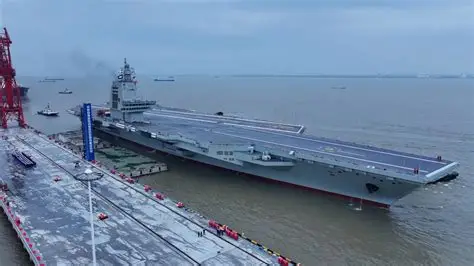
China has officially commissioned its most advanced and ambitious warship to date — the Fujian, the People’s Liberation Army Navy’s (PLAN) third aircraft carrier and the first designed and built entirely to modern Chinese specifications. The commissioning ceremony, attended by President Xi Jinping, took place after months of intensive sea trials in the South China Sea, signaling a major leap forward in Beijing’s naval modernization drive and its ambitions to project power far beyond regional waters.
A New Era for Chinese Carrier Aviation
Constructed at the CSSC Jiangnan Shipyard, the Fujian represents a decisive break from the past. While China’s earlier carriers — the Liaoning and Shandong — were based on Soviet blueprints and used short takeoff systems, the Fujian is a fully indigenous, conventionally powered flat-top designed with the latest technologies. It is also the first Chinese carrier equipped with catapult launch systems, a defining feature of modern naval aviation that allows heavier aircraft to take off with full fuel and weapon loads.
The introduction of catapult-assisted takeoff dramatically enhances the operational flexibility of the Fujian’s air wing. Unlike the ski-jump systems on China’s earlier vessels, the catapults on the Fujian enable aircraft to launch with maximum payload, extending both their range and combat power. This capability also allows the launch of larger support aircraft, including early warning and control planes — a critical component of sustained, blue-water operations.
EMALS: A Technological Leap Forward
In a striking technological choice, Chinese engineers opted to bypass traditional steam catapult systems altogether. Under the direct guidance of President Xi Jinping, the Fujian has been fitted with a DC electromagnetic aircraft launch system (EMALS), a sophisticated innovation previously deployed only on the U.S. Navy’s USS Gerald R. Ford.
The U.S. Navy’s experience with EMALS was fraught with delays and technical setbacks during the Ford’s early operational period. Although Beijing has not disclosed detailed data on the reliability or performance of its system, state media have released extensive video evidence showing successful launch and recovery operations of multiple aircraft, including the J-35 stealth fighter and the KJ-600 airborne early warning aircraft — both symbols of China’s growing aerospace prowess.
Expanding Reach and Strategic Depth
With a larger flight deck, higher sortie generation rate, and more capable air wing, the Fujian gives the PLAN a substantial increase in operational reach. Military analyst Zhang Junshe, speaking to the state-owned Global Times, emphasized that while Liaoning and Shandong were optimized for coastal defense and regional missions, the Fujian enables “far seas operations.”
Its ability to launch stealth fighters and early warning aircraft extends China’s naval aviation range deep into the western Pacific and Indian Oceans, bringing it closer to parity with long-established carrier powers like the United States. This new capability also supports Beijing’s broader goals of protecting global maritime trade routes and securing its overseas interests.
The Next Generation of Chinese Carriers
The Fujian is not the end of the story. Reports from Chinese shipyards indicate that a fourth carrier is already under construction, and analysts believe it could be nuclear-powered, matching the endurance and power generation capabilities of U.S. supercarriers. If confirmed, such a step would mark a watershed moment in China’s evolution into a true blue-water navy.
However, experts caution that the PLAN’s carrier program, though rapid in progress, remains in a developmental phase. According to Aita Moriki of Japan’s National Institute for Defense Studies, this moment marks “not the completion of operational deployment, but rather the starting point for challenges.” Moriki notes that the PLAN must still refine the reliability of its EMALS and arresting systems, build a robust operational doctrine, and train a new generation of carrier-qualified pilots — an endeavor that took Western navies decades to perfect.
https://x.com/visegrad24/status/1970079391930634542
Strategic Timing and Diplomatic Undertones
The commissioning of the Fujian comes at a moment of renewed engagement between Beijing and Washington. Just days before the ceremony, President Xi Jinping met with U.S. President Donald Trump in Busan, South Korea, in a high-stakes discussion that helped ease months of trade tension between the two nations.
Following the meeting, Trump announced a one-year suspension of planned port fees on Chinese vessels, a key part of his administration’s strategy to challenge Chinese dominance in global shipbuilding. In return, Xi agreed to relax export controls on rare earth elements — materials critical to U.S. defense and technology industries.
While both sides framed the outcome as a pragmatic step toward stability, the timing of the Fujian’s commissioning unmistakably underscores China’s growing confidence — both diplomatically and militarily — as it asserts itself as a peer competitor to the United States on the world stage.
Conclusion: Power Projection with Chinese Characteristics
The Fujian’s entry into service is a defining symbol of China’s transformation from a regional maritime force into a global naval power. It embodies the country’s mastery of complex technologies, its drive for self-reliance, and its ambition to rival the world’s premier military powers.
Yet, despite its impressive scale and sophistication, the Fujian is also a reminder of how far China still has to go — in experience, logistics, and combat readiness. As the PLAN continues to expand its carrier fleet and refine its doctrines, the Fujian will serve not just as a flagship of naval modernization, but as a proving ground for China’s future on the high seas.