|
Getting your Trinity Audio player ready...
|
Welding sparks, cutting torches, and other forms of “hot work” are unavoidable in the maintenance and modernization of U.S. Navy warships. But they also represent one of the most persistent and dangerous risks facing vessels in shipyards: fire. Despite reforms enacted after one of the most devastating naval ship fires in modern U.S. history, a new assessment by the U.S. Government Accountability Office (GAO) warns that critical weaknesses continue to undermine the Navy’s fire prevention efforts during ship maintenance periods.
At the center of the GAO’s findings is a sobering conclusion: while the Navy has improved fire safety culture and procedures since the 2020 inferno aboard the USS Bonhomme Richard, staffing shortages and ineffective contractor accountability tools threaten to reverse that progress.
A Wake-Up Call: The USS Bonhomme Richard Fire
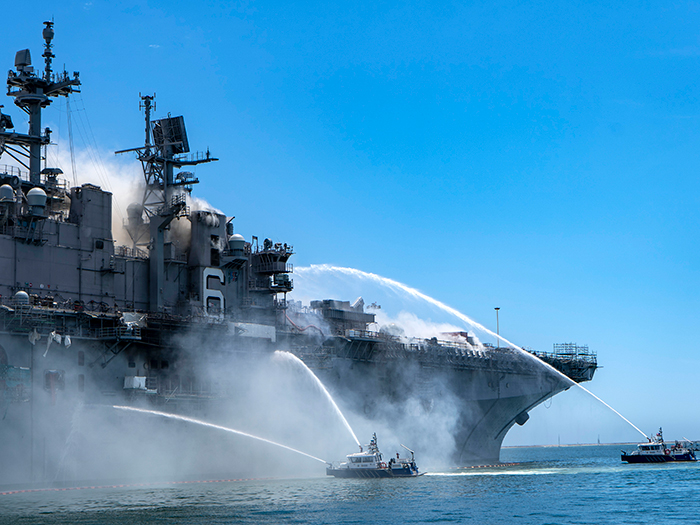
The July 2020 fire aboard the Wasp-class amphibious assault ship USS Bonhomme Richard (LHD 6) stands as a defining moment for the Navy’s approach to shipyard fire safety. The blaze, which burned for nearly five days while the ship was undergoing maintenance in San Diego, ultimately gutted the vessel and caused more than $3 billion in damage. The ship was later decommissioned and scrapped, marking one of the most costly non-combat losses in U.S. naval history.
Investigations revealed a cascade of failures: inadequate fire watch procedures, poor material storage practices, delayed response, insufficient training, and weak oversight of contractors responsible for shipyard work. The incident sent shockwaves through the Navy and prompted a comprehensive review of fire prevention practices across the fleet.
In response, the Navy launched a series of reforms aimed at strengthening shipyard fire safety, improving coordination between sailors and contractors, and instilling a stronger safety culture across maintenance operations.

GAO Says U.S. Navy Must Do More to Prevent Ship Fires
Measured Progress—But an Uneven Landscape
According to GAO, those reforms have yielded tangible results. Since the Bonhomme Richard fire, the Navy reports no major ship fires during maintenance periods, a notable improvement given the service’s history. Between 2008 and 2020, the Navy experienced 13 significant ship fires on vessels undergoing maintenance—each resulting in operational disruption, costly repairs, or permanent loss.
GAO acknowledges that changes implemented since 2020 have improved both awareness and procedural compliance among sailors and contractors alike. Fire prevention training has been expanded, coordination mechanisms have been refined, and safety expectations are more clearly articulated.
Yet beneath this surface-level progress, the watchdog agency found systemic weaknesses that, if left unaddressed, could reintroduce unacceptable risk.
Staffing Shortages Undermine Oversight
One of GAO’s most significant findings centers on staffing shortfalls across the Navy organizations responsible for overseeing fire safety during ship maintenance. These include shore-based commands, maintenance authorities, and quality assurance teams charged with ensuring contractors comply with safety standards.
Personnel shortages, GAO warns, limit the Navy’s ability to consistently enforce fire safety requirements. In practice, this has led to increased reliance on sailors to fill oversight gaps—sailors who already carry demanding operational, administrative, and training responsibilities.
“The burden placed on sailors is unsustainable,” GAO concluded, noting that divided attention increases the likelihood of oversight lapses. When sailors are forced to juggle fire watch duties alongside unrelated tasks, the effectiveness of fire prevention measures diminishes.
The risk is compounded during complex maintenance availabilities, when multiple contractors operate simultaneously in confined shipboard spaces, increasing the likelihood of ignition sources interacting with flammable materials.
Contractor Oversight: Tools Without Teeth
Beyond staffing concerns, GAO found that the Navy’s contractor oversight mechanisms—while well-established on paper—often lack the enforcement power needed to compel compliance.
The Navy relies on several tools to hold ship repair contractors accountable for meeting fire safety standards. GAO’s review, however, found each of these tools suffers from structural limitations.
Corrective Action Requests: Warnings Without Consequences
Corrective Action Requests (CARs) are one of the Navy’s primary methods for addressing contractor noncompliance. These formal notices identify deficiencies and require corrective measures.
However, GAO found that the CAR process does not include monetary penalties, even for repeated or severe violations. As a result, contractors may view CARs as administrative warnings rather than meaningful deterrents.
Notably, prior to the Bonhomme Richard fire, the Navy had issued numerous CARs related to fire safety—including a severe warning—yet the underlying issues persisted.
“The absence of financial consequences reduces the effectiveness of the process,” GAO concluded.
Quality Assurance Surveillance Plans: Missed Opportunities
Quality Assurance Surveillance Plans (QASPs) are designed to link contractor performance with payment, allowing the Navy to assess penalties for noncompliance with contract requirements.
GAO reviewed QASPs for six ship maintenance contracts and found a consistent omission: fire safety performance standards were not included. Additionally, Navy guidance governing these plans failed to require the evaluation of safety-related deficiencies when determining payment reductions.
This gap means that contractors can violate safety protocols without facing financial repercussions, even when those violations pose significant risk to ships and personnel.

Progress Payment Retention: A Blunted Instrument
Another accountability mechanism is progress payment retention. Under this system, the Navy withholds a portion of contractor payments until work is completed satisfactorily.
However, GAO found that the Navy continues to apply a reduced retention rate initially implemented during the COVID-19 pandemic to support the struggling industrial base. While understandable during the crisis, GAO argues that maintaining this reduced rate diminishes the Navy’s leverage in enforcing safety standards.
The watchdog agency recommends reassessing retention rates to balance industrial base health with the government’s exposure to financial and operational risk.
Contractor Liability Caps: An Outdated Safeguard
Perhaps the most consequential finding relates to contractor liability. The Navy’s limitation of liability clause for ship repair contractors has remained unchanged since 2003.
Over two decades later, inflation and the increasing complexity of ship systems mean that the liability cap now represents a far smaller share of potential losses. In cases of catastrophic damage—such as a major fire—the government bears a disproportionate share of the financial burden.
GAO concluded that the current liability framework inadequately reflects modern ship maintenance realities and places taxpayers at unnecessary risk.

GAO’s Six Recommendations
To address these systemic shortcomings, GAO issued six recommendations, all of which the Navy has formally accepted.
-
Maximize Fire Safety Oversight Resources
GAO recommends developing a mechanism to better allocate personnel across organizations responsible for fire safety oversight, reducing reliance on sailors and improving consistency. -
Integrate Contractor Compliance into Post-Incident Reviews
Future investigations of major ship fires should explicitly assess contractor adherence to fire safety standards, including a review of corrective action histories. -
Strengthen the Corrective Action Request Process
GAO urges the Navy to evaluate whether incorporating monetary penalties into the CAR process would improve contractor accountability. -
Update Quality Assurance Surveillance Plan Guidance
Fire safety performance standards should be explicitly included in QASPs and related guidance. -
Reassess Progress Payment Retention Rates
Retention rates should reflect current risk levels and the financial health of the ship repair industrial base. -
Modernize Contractor Liability Limits
The Navy should reassess liability caps to account for inflation and modern ship maintenance costs and recommend updates to the Defense Federal Acquisition Regulation Supplement.
A Fragile Balance Between Reform and Risk
The GAO report paints a picture of an institution at a crossroads. The Navy has demonstrated that meaningful reform is possible—evidenced by the absence of major ship fires since 2020. But progress remains fragile.
Staffing shortages, diluted enforcement mechanisms, and outdated contractual safeguards threaten to erode the gains made in the wake of the Bonhomme Richard disaster. As ships grow more complex and maintenance periods lengthen, the margin for error continues to shrink.
Fire, once ignited aboard a ship in maintenance, spreads with ruthless efficiency. Preventing the next catastrophe will depend not only on procedures and training, but on sustained investment in oversight, accountability, and institutional vigilance.
As GAO’s findings make clear, fire safety in naval shipyards is not merely a technical challenge—it is a test of governance, discipline, and the Navy’s commitment to protecting its fleet before disaster strikes again.