|
Getting your Trinity Audio player ready...
|
In yet another flare-up of the ongoing maritime tensions in the South China Sea, the Philippines and China have exchanged sharp accusations following a series of confrontations in the disputed waters near the Spratly Islands. While no injuries were reported, the incidents once again underscored the volatility of the region, with both nations accusing the other of provocation and violation of sovereignty.
According to the Philippine Coast Guard (PCG), two separate resupply missions—on October 8 and October 11—were met with increasingly aggressive tactics from Chinese vessels, including the use of water cannons, dangerous close-quarter maneuvers, and what was described as a “deliberate ramming” of a Philippine government ship.
A Familiar Flashpoint Rekindled
The latest standoff began on October 8, when the Philippines launched a routine resupply mission to support its personnel stationed in the Spratly Islands. The mission, which followed aerial reconnaissance the previous day revealing the presence of numerous Filipino fishing boats in the area, quickly encountered heightened Chinese activity.
A spokesperson from the PCG reported that Chinese vessels broadcasted warnings of a “live fire exercise” and engaged in what the Philippines called “intimidation tactics.” Despite the tension, the mission was successfully completed. “We observed an increased Chinese maritime presence and multiple overflights targeting both our fishermen and our government vessels,” the spokesperson said.
China, however, maintains that the Philippines was operating illegally within what Beijing now describes as a marine environmental reserve—a designation unrecognized by Manila. Chinese officials claimed that Filipino fishing boats were damaging the marine ecosystem, allegations the Philippines firmly denies, asserting that the waters lie squarely within its Exclusive Economic Zone (EEZ) under international law.
“The Philippines alone has the right to enforce environmental protection measures within its EEZ,” said a Philippine government official. “China’s actions are not only illegal but also hypocritical, given the extensive environmental destruction caused by its artificial island-building activities.”
Escalation on October 11: “Deliberate Ramming”
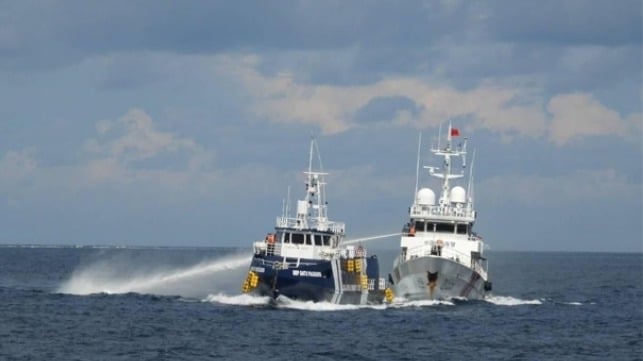
Tensions reached a new height on October 11, when a second resupply mission encountered direct physical aggression from Chinese maritime forces. The Philippine Coast Guard reported that China Coast Guard vessel 21559 used its high-pressure water cannon against the BRP Datu Pagbuaya, a Philippine government vessel, before deliberately ramming its stern just three minutes later.
The PCG described the event as a “deliberate and dangerous act of aggression”, resulting in minor structural damage to the Filipino ship. “These maneuvers could have caused serious harm to our crew,” said the PCG spokesperson. “The safety of our personnel and the freedom of navigation are being continuously undermined by China’s reckless behavior.”
Beijing, in turn, accused the Philippines of orchestrating “violations and provocations.” A spokesperson from China’s Foreign Ministry stated that the “responsibility lies entirely with the Philippine side,” insisting that Chinese forces were acting within their territorial jurisdiction to defend national sovereignty.
Renewed Tensions on October 13: Water Cannons and Blockades
Just two days later, on October 13, the situation intensified further as the Philippines carried out two additional supply missions in the same area, including near Thitu Island—known locally as Pag-asa Island—where the Philippines maintains a small garrison and a civilian community.
According to Jay Tarriela, spokesperson for the Philippine Coast Guard, Chinese Coast Guard and maritime militia vessels again attempted to block the resupply operation. At the first location, Tarriela reported the presence of 11 China Coast Guard vessels, 11 militia ships, a People’s Liberation Army (PLA) helicopter, and three PLA Navy vessels.
“The Chinese attempted to assert that we were operating inside their so-called environmental reserve,” Tarriela said. “However, our vessels remained calm and professional while proceeding with their lawful activities.”
At the second location, the confrontation escalated as 10 China Coast Guard vessels, 10 militia ships, a PLA helicopter, two PLA Navy vessels, and a high-speed response boat surrounded the Philippine flotilla. Once again, water cannons were deployed by the Chinese in an effort to prevent the mission.
Despite the aggression, the BRP Melchora Aquino and BRP Cabra successfully shielded five Bureau of Fisheries and Aquatic Resources (BFAR) patrol boats, allowing them to complete their supply run. The Philippine government also confirmed that it is purchasing the catch directly from Filipino fishermen to support their livelihoods amid the escalating tensions.
“We Will Defend Every Square Inch”
In a firm statement following the incidents, Admiral Ronniel Gil Gavan, Commandant of the Philippine Coast Guard, vowed that the country would not be intimidated.
“My top priority is to safeguard the livelihoods of our fishermen from any interference by the China Coast Guard and to ensure their rights as Filipinos are never suppressed by external bullying,” Gavan declared. “We stand firmly with President Ferdinand Marcos Jr. in defending every square inch of our sovereign territory against any foreign power.”
Manila has repeatedly emphasized that its operations are legitimate, lawful, and essential for supporting Filipino personnel stationed in the region and sustaining local fishing communities who depend on the surrounding waters.
https://x.com/jaytaryela/status/1977200736196083745
China’s Response: “Stop the Provocations”
In Beijing, the Chinese Foreign Ministry doubled down on its accusations, urging the Philippines to halt what it described as “provocative and reckless actions.”
A ministry spokesperson asserted that “China has indisputable sovereignty over the Nansha Islands (Spratly Islands) and their adjacent waters,” and warned that “the Philippines must immediately stop its violations, otherwise it will bear all consequences.”
The spokesperson added that Chinese maritime forces will “continue to safeguard China’s territorial integrity and maritime rights,” language that echoes Beijing’s long-standing claims across nearly the entire South China Sea.
A Pattern of Confrontation
The recent series of incidents marks yet another episode in the long-running dispute between the two nations. Over the past year, the Philippines has repeatedly reported Chinese harassment of its vessels, including the use of lasers, water cannons, and dangerous blockades.
While Manila insists it is merely exercising its rights within its internationally recognized EEZ, Beijing continues to assert sweeping historical claims that overlap with the maritime boundaries of multiple Southeast Asian countries.
Analysts warn that the increasing frequency and severity of these encounters risk sparking a serious confrontation. “Each of these incidents brings the region a step closer to a potential accident or escalation that neither side wants,” said a maritime security expert based in Manila. “The combination of nationalism, proximity, and high-stakes sovereignty claims creates a combustible situation.”
https://x.com/jaytaryela/status/1977743573643903348
Standing Firm Amid Pressure
Despite mounting pressure, the Philippine government has reiterated its commitment to maintaining a presence in the Spratly Islands and ensuring the safety of its fishermen. President Ferdinand Marcos Jr. has called on China to respect international law, particularly the 2016 Hague Tribunal ruling, which invalidated Beijing’s expansive claims in the South China Sea—a verdict China continues to reject.
As both sides reinforce their positions, the situation remains tense. The Philippine Coast Guard continues to assert that its missions will go on, undeterred by what it calls “China’s coercive and unlawful tactics.”
For now, the waters around the Spratly Islands remain calm on the surface, but beneath lies a deep current of geopolitical friction that could yet reshape the balance of power in one of the world’s most contested maritime regions.