|
Getting your Trinity Audio player ready...
|
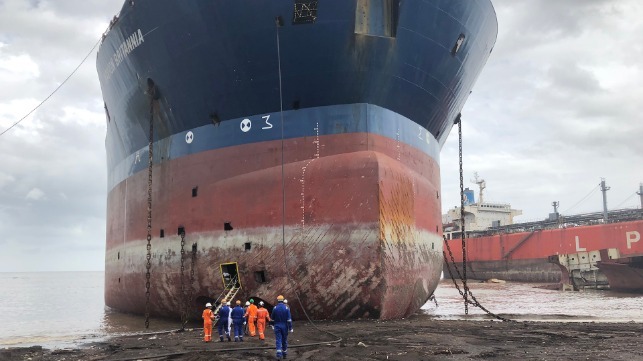
Three months after the Hong Kong International Convention for the Safe and Environmentally Sound Recycling of Ships (HKC) entered into force, the global ship recycling landscape looks remarkably familiar. The yards remain active, the paperwork continues to pile up, and the sweeping transformation once envisioned has yet to materialize.
A Slow Start to a Long-Awaited Reform
The slow pace of change surprises no one within the maritime sector. The HKC took more than a decade to come into effect, and the industry had years to prepare for its eventual arrival. In truth, many shipowners had already moved in that direction, aligning their operations with the European Union Ship Recycling Regulation (EU SRR), which set stricter standards and effectively accelerated global compliance well before the IMO framework became law.
Since 2020, most actively trading vessels have been required to maintain a certified and regularly updated Inventory of Hazardous Materials (IHM) — a cornerstone of both the EU SRR and the HKC. Maintaining such inventories has become a routine aspect of vessel management, meaning the HKC’s entry into force represents more of a formalization than a revolution.
Finance, Not Regulation, Has Driven Compliance
If there has been a true driver of progress, it has not been regulation but finance. Over recent years, the financial sector has taken the lead through Environmental, Social, and Governance (ESG) criteria, making HKC-level compliance a prerequisite for loans and investment. In other words, shipowners did not wait for the IMO’s enforcement — they responded to the demands of financiers.
This top-down pressure has undoubtedly raised awareness but has not necessarily transformed behavior. Today, compliance is viewed as the baseline — the minimum requirement to operate responsibly — rather than as a mark of excellence.
A New Layer of Accountability for Shipowners
Despite its modest beginnings, the HKC has changed the regulatory landscape in important ways. It provides, for the first time, a unified global framework for the safe and sustainable recycling of ships. Yet significant ambiguity remains, especially in relation to the Basel Convention on the Control of Transboundary Movements of Hazardous Wastes, which still classifies end-of-life vessels as hazardous waste.
For shipowners, this overlap creates a dual compliance burden. They must now satisfy both HKC and Basel Convention obligations — a complex task involving documentation, logistics, and jurisdictional navigation. The days of relying solely on intermediaries or brokers to handle end-of-life disposal are fading.
Owners must now take direct responsibility for the accuracy and integrity of their compliance systems, ensuring that IHMs, recycling plans, and accompanying documentation are accurate, auditable, and aligned across frameworks. Outsourcing risk will no longer suffice. Compliance, in this new era, demands active participation, transparency, and continuous verification from the vessel’s first voyage to its final one.
Early Signs of Change: Compliance Beyond Paper
At Idwal, where global vessel inspections have continued through the first months of HKC enforcement, subtle yet meaningful changes have begun to emerge. Shipowners are now asking tougher questions. They seek assurance that documentation truly reflects on-the-ground conditions — that the IHMs and recycling plans correspond to the vessel’s physical reality.
It’s a small but positive sign that the HKC’s influence is extending beyond bureaucracy and beginning to shape operational behavior.
The Capacity Crunch: A Two-Tier Market Emerges
However, the Convention’s rollout has revealed a new bottleneck. Only a limited number of recycling yards currently hold HKC certification, and many of those are already operating near capacity. Achieving and maintaining HKC-compliant certification requires substantial financial investment and technical capability, which has created a two-tier global market: certified versus non-certified yards.
For shipowners with aging fleets, this scarcity presents a looming risk. Those who delay in securing recycling slots may find that compliant facilities are fully booked when they are most needed. Planning ahead is no longer optional — it is strategic necessity.
Enforcement Will Define Success
The ultimate success of the Hong Kong Convention will depend not on its written text but on how it is enforced. The European experience provides an important lesson: under the EU SRR, port state control made the critical difference. European authorities detained ships for IHM deficiencies and imposed strict penalties, sending a clear message that compliance was not negotiable.
For the HKC to achieve similar credibility, firm enforcement, random inspections, and transparent penalties must follow. Without them, the Convention risks devolving into another paper-based exercise — full of documentation but empty of accountability.
Passing an audit does not equate to true compliance. Genuine conformity requires independent verification, randomized inspections, and clear evidence that the ship’s documentation matches its physical condition.
Idwal’s global inspection data continues to reveal discrepancies between declared and observed hazardous materials aboard vessels — an indication that paperwork alone cannot ensure safety. Only impartial, third-party verification can close this persistent gap between policy and practice.
Technology as a Catalyst for Credible Compliance
Technology is poised to play a central role in this transition. Data-driven inspection tools, digital IHMs, and shared verification platforms enable transparency at scale, empowering owners and managers to validate compliance across their fleets in real time.
Digital reporting not only enhances traceability but also allows for trend analysis, deficiency tracking, and risk-based decision-making. Through these systems, shipowners gain a clearer view of recurring compliance issues and can implement proactive corrective actions rather than reactive fixes.
Moreover, technology-backed inspections allow for independent oversight throughout the vessel’s lifecycle — not just at the point of recycling. Randomized and multi-stage inspections ensure that compliance is consistent and continuous, rather than something achieved only when auditors are expected.
Embedding Compliance into Everyday Operations
True sustainability in ship recycling depends on embedding compliance within day-to-day operations. This means integrating independent inspection and auditing not just at end-of-life, but throughout a vessel’s service years.
Shipowners and managers must also establish robust compliance management systems, supported by ongoing training for both seafarers and shore-based staff. Regulatory awareness must become part of the organizational culture, not a box to be ticked once a year.
By combining independent verification, digital oversight, and sound management practices, the industry can ensure that HKC compliance is not merely a bureaucratic exercise, but a credible and verifiable standard of safety and environmental care.
From Declarations to Verification
Three months after enforcement began, the industry has produced enough declarations and certification documents. What it truly needs now is verification — tangible evidence that the commitments made on paper are being realized in the yards and onboard ships around the world.
Market Conditions: The Economic Reality Behind Recycling
The effectiveness of the HKC will also depend on the economic climate. If recycling market rates remain low, the current trend is likely to persist: shipowners will opt to extend the operational life of older vessels or sell them into secondary markets rather than send them for dismantling.
Some of these aging ships may find new employment in domestic or regional trades, generating additional revenue before their eventual disposal. This strategy allows owners to capture more value than recycling prices alone might offer.
In this environment, fleet-level oversight and data-driven monitoring become essential. Shipowners must track condition, value, and compliance across entire fleets to make informed decisions about when to recycle, sell, or refit.
Conclusion: Turning Standards into Substance
After more than a decade of anticipation, the Hong Kong Convention represents an important step forward — but its promise will only be fulfilled if the industry transforms compliance from a static obligation into a living standard.
Independent verification, transparent oversight, and technological integration are the cornerstones of that transformation. Without them, the HKC risks becoming another well-intentioned framework remembered more for its paperwork than for its progress.
The global shipping industry has waited long enough for this reform. Now, its task is not to comply, but to prove that compliance means something.