|
Getting your Trinity Audio player ready...
|
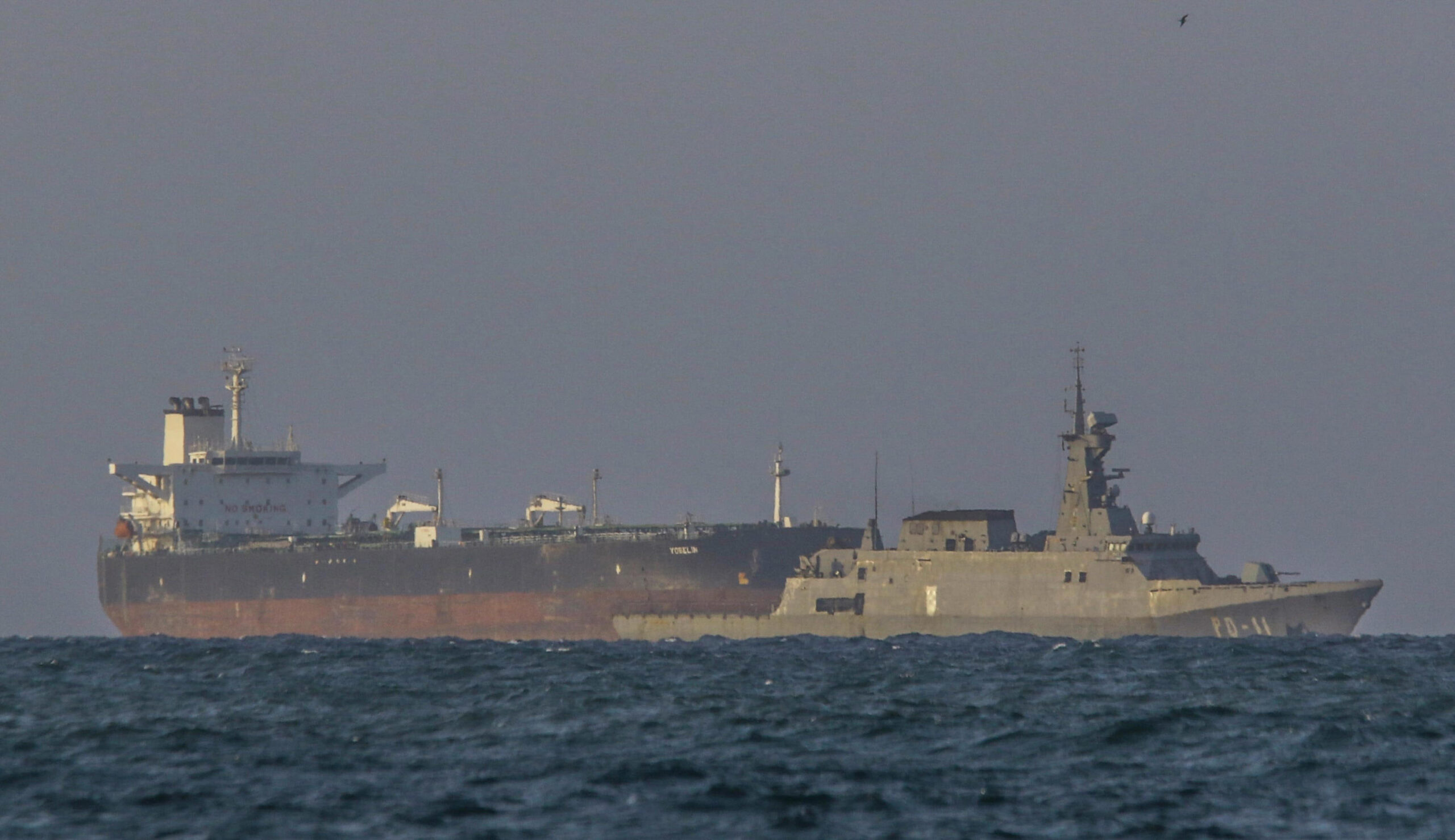
In a significant escalation of maritime sanctions enforcement, the United States Department of Defense confirmed that American forces have successfully intercepted a third sanctioned oil tanker in the Indian Ocean. The vessel, identified as the Bertha, was stopped on February 24 following what officials described as a long-range tracking effort that began in the Caribbean and extended thousands of miles across open waters.
The interdiction follows earlier operations involving two other tankers — the Aquila II and the Veronica III — both of which were also stopped in the Indian Ocean after departing Venezuelan waters. Together, the three ships were reportedly part of a group that had fled the Caribbean carrying crude oil believed to originate from Venezuela, with indications that the cargoes were ultimately bound for buyers in Asia, most likely refiners in China.
A Long-Distance Maritime Pursuit
According to Pentagon officials, the Bertha departed Venezuela in early January carrying approximately 1.9 million barrels of heavy crude. From the moment it left Caribbean waters, U.S. authorities began monitoring its movements as part of an expanded sanctions enforcement initiative targeting vessels accused of transporting restricted oil supplies.
Defense officials stated that the ship was intercepted in international waters off the Maldives during what was described as a “right-of-visit, maritime interdiction, and boarding operation.” The boarding reportedly occurred without resistance or incident, and the crew complied with U.S. forces.
In a strongly worded public statement, the Pentagon emphasized that international waters do not provide immunity for vessels operating in violation of sanctions. The message underscored Washington’s determination to pursue sanctioned actors “by land, air, or sea,” signaling a broadened operational scope that stretches far beyond the Western Hemisphere.
The Vessel’s Sanctions History
The Bertha, a 305,442-deadweight-ton very large crude carrier built in 2004, has a complicated regulatory history. U.S. authorities sanctioned the vessel in 2024 for alleged involvement in Iranian oil exports, linking it to activities associated with the Iranian energy trade since at least 2022. The tanker has reportedly operated under multiple aliases, including Monica S, and has been associated with Shanghai Legendary Ship Management Company Limited.
Although the vessel was once listed as registered in the Cook Islands, the Maritime Cook Islands announced earlier this year that it had canceled the ship’s registry in November 2024. The registry clarified that the cancellation occurred prior to the formal U.S. sanctions designation. Despite this, maritime tracking databases later showed the vessel broadcasting conflicting or questionable flag information, at times claiming registration in Curaçao.
Lloyd’s Register withdrew its classification of the vessel in December 2024, a move that typically reflects regulatory or compliance concerns. Industry databases list the tanker’s last known port state inspection as April 2024, adding further complexity to its compliance record.
The Broader Enforcement Campaign
The interdiction of the Bertha is not an isolated incident but part of a broader maritime enforcement strategy launched by the United States in late 2025. Since December, U.S. forces have reportedly stopped at least ten tankers suspected of carrying sanctioned crude from Venezuela or engaging in other prohibited energy trade activities.
Some of these vessels have been released following inspection, while others remain under investigation. One tanker, the Marinera (also known as Bella 1), was tracked into the Atlantic Ocean, seized, and later escorted to Scotland. The captain of that vessel was subsequently indicted by U.S. authorities on charges including sailing under a false flag and failing to comply with U.S. Coast Guard directives.
Officials describe these actions as part of a strategy to enforce what they refer to as a “quarantine of sanctioned vessels” in the Caribbean — a policy aimed at preventing ships from carrying Venezuelan crude in violation of U.S. sanctions. The recent operations demonstrate that enforcement is no longer confined to the Atlantic or Caribbean regions but now extends into the Indian Ocean and potentially beyond.
The “Shadow Fleet” Phenomenon
Maritime analysts point to the growing use of so-called “shadow fleet” tactics as a key factor driving these enforcement measures. Tankers operating within this informal network frequently employ methods designed to obscure the origin and destination of their cargo.
Common tactics include disabling or manipulating Automatic Identification System (AIS) transponders, conducting ship-to-ship transfers in remote waters, falsifying documentation, or operating under multiple vessel names and flags. These strategies make it difficult for regulators and shipping authorities to track oil shipments linked to sanctioned entities.
The Bertha reportedly displayed several of these hallmarks. Tracking firms observed irregular AIS signals and noted discrepancies between its broadcast location and its actual route. Such practices, while not uncommon in sanctioned oil trades, have drawn increasing scrutiny from governments seeking to enforce economic restrictions.
Legal and Diplomatic Questions
The interception of vessels in international waters inevitably raises legal and diplomatic questions. Under international maritime law, ships are generally subject to the jurisdiction of the state whose flag they fly. However, vessels that lack valid registration or are suspected of falsely claiming a flag may be treated as stateless, allowing for boarding under certain conditions.
U.S. officials argue that these interdictions are consistent with international legal principles, particularly when a vessel is operating without legitimate flag authority or in violation of sanctions law. Critics, however, caution that aggressive enforcement in distant waters could set precedents affecting freedom of navigation.
The governments of Venezuela and China have not issued detailed official responses to the seizure of the Bertha. Venezuela has consistently condemned U.S. sanctions as unlawful and economically coercive, while China has maintained that it conducts energy trade in accordance with its national interests and international obligations.

US Forces Intercept Third Sanctioned “Runaway” Oil Tanker in Indian Ocean Operation
Energy Market Implications
Although the seizure of a single tanker is unlikely to significantly disrupt global oil markets, the cumulative effect of repeated interdictions may alter trade flows. Venezuelan crude exports have already fluctuated in recent years due to sanctions, shifting political dynamics, and evolving licensing arrangements.
For global refiners, especially those equipped to process heavy crude grades, the uncertainty surrounding Venezuelan shipments may increase reliance on alternative suppliers. Meanwhile, tanker owners and insurers face heightened compliance risks when operating in regions associated with sanctioned cargo.
Insurance underwriters and classification societies have tightened scrutiny of vessels suspected of sanctions exposure. The withdrawal of classification, as seen in the case of the Bertha, can significantly limit a ship’s ability to operate legally in international trade.
A Message of Deterrence
From a strategic perspective, U.S. officials appear intent on sending a clear deterrent message. By publicly announcing the tracking and interdiction of vessels across oceans, Washington aims to demonstrate that distance offers no protection against enforcement action.
Defense analysts note that such operations require substantial logistical coordination, including satellite surveillance, maritime patrol aircraft, naval assets, and legal oversight. The successful interception of three tankers in the Indian Ocean within weeks reflects a coordinated effort involving multiple branches of the U.S. military.
The Pentagon’s messaging emphasizes that sanctions enforcement is not merely symbolic but operational. By extending interdictions beyond traditional regional boundaries, U.S. authorities are signaling a willingness to pursue sanctioned shipments wherever they travel.
What Comes Next
The future of the Bertha remains uncertain. Authorities have not disclosed whether the vessel will be escorted to a specific port, held pending legal proceedings, or released following inspection. Investigations into ownership structures, cargo documentation, and crew compliance are likely underway.
Observers expect additional enforcement actions if other vessels attempt similar voyages. Maritime intelligence firms have reported continued monitoring of tankers departing Venezuelan waters under unusual routing patterns.
The broader geopolitical implications may unfold over time. As sanctions enforcement intensifies, shipping companies and energy traders may recalibrate their risk assessments. At the same time, countries targeted by sanctions may explore alternative methods of transporting crude, potentially deepening the cat-and-mouse dynamic between regulators and traders.

Conclusion
The interception of the Bertha in the Indian Ocean marks a significant development in the United States’ campaign to enforce sanctions against Venezuelan oil exports. By pursuing and boarding a sanctioned vessel thousands of miles from its origin, U.S. forces have demonstrated both operational reach and political resolve.
As maritime enforcement efforts expand, the global shipping industry faces increased scrutiny, heightened compliance demands, and growing geopolitical tension. Whether these measures will substantially curb sanctioned oil flows remains to be seen, but the message from Washington is unmistakable: sanctioned vessels will be tracked, pursued, and, if necessary, stopped — wherever they sail.