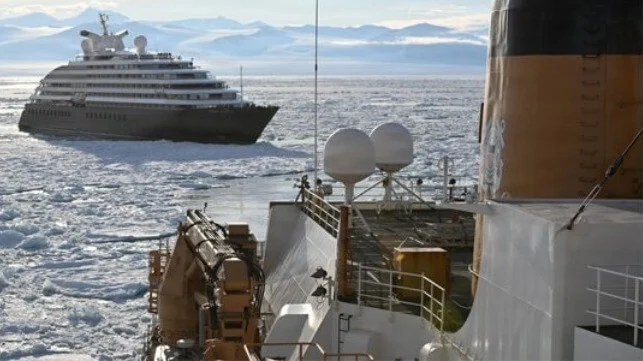
As the United States Coast Guard’s most iconic icebreaker marked half a century of service, the USCG Cutter Polar Star underscored her enduring strategic value with a dramatic real-world rescue in one of the most hostile environments on Earth. Celebrating 50 years since her commissioning, the aging yet formidable vessel freed a luxury expedition cruise ship trapped by dense Antarctic pack ice—an achievement that highlights both the cutter’s unmatched capabilities and the growing importance of polar operations.
The rescue occurred during Polar Star’s 29th deployment to Antarctica, where she is currently supporting Operation Deep Freeze, the annual logistical and tactical mission that sustains the United States’ presence on the southernmost continent. Despite her age, Polar Star remains the only active heavy icebreaker in the U.S. fleet, a fact that continues to place extraordinary operational demands on the vessel and her crew.
A Half-Century of Service in the World’s Harshest Waters
Commissioned on January 17, 1976, Polar Star entered service during the Cold War, when polar dominance was considered a strategic imperative. Five decades later, the cutter continues to serve as a linchpin of U.S. operations in extreme latitudes.
Displacing 13,500 tons, the vessel stretches 399 feet (122 meters) in length and draws 34 feet (10 meters) of water. According to U.S. Coast Guard data, Polar Star remains the world’s most powerful non-nuclear icebreaker, a distinction that reflects both her original engineering and decades of meticulous maintenance.
Powered by a massive propulsion system capable of producing up to 75,000 shaft horsepower, the cutter can break through solid ice up to 21 feet (6.4 meters) thick using a specialized backing-and-ramming technique. In less extreme conditions, she can steam continuously through six feet (1.8 meters) of ice at speeds of up to three knots, enabling sustained operations across vast frozen seascapes.

USCG Cutter Polar Star Marks 50th Anniversary With Dramatic Antarctic Ice Rescue
Emergency Call in Antarctic Waters
The milestone rescue unfolded on Friday night, January 16, when Polar Star received a distress call from the Scenic Eclipse II, a luxury expedition cruise ship operating in Antarctic waters.
According to the U.S. Coast Guard, the 17,592-gross-ton vessel reported that it had “become beset in pack ice roughly eight nautical miles from McMurdo Sound.” While the Scenic Eclipse II is built with an ice-rated hull and is designed for polar tourism, Antarctic conditions can change rapidly, turning navigable waters into impenetrable ice fields within hours.
Carrying up to 200 passengers during Antarctic voyages, the ship was not in immediate danger, but prolonged entrapment in pack ice presents serious operational and safety risks, particularly in one of the most remote regions on the planet.
Precision Icebreaking Operation
Responding swiftly, Polar Star altered course and made her way to the stranded vessel. Upon arrival, the cutter executed two close, carefully controlled passes, using her immense power and reinforced hull to fracture the surrounding ice without endangering the cruise ship.
The operation required exceptional seamanship, as icebreaking near another vessel demands precise maneuvering to avoid hull damage while ensuring effective ice clearance. Once freed, the Scenic Eclipse II was escorted approximately four nautical miles to open water, restoring her ability to safely navigate away from the ice field.
Photographs released by the U.S. Coast Guard show the cruise ship trailing behind the massive red-hulled icebreaker, a striking visual reminder of Polar Star’s continued relevance.
A Testament to Crew and Legacy
Reflecting on the rescue and the cutter’s milestone anniversary, Cmdr. Samuel Blase, executive officer of Polar Star, emphasized the human element behind the ship’s longevity.
“At 50 years old, Polar Star remains the world’s most capable non-nuclear icebreaker,” Blase said. “That’s a testament to the crews that have maintained it over the decades. With years of service left to give, Polar Star will continue to guide the way in the high latitudes well into the future.”
His remarks underscore a broader truth within the Coast Guard: while steel and horsepower matter, it is the expertise of generations of sailors and engineers that has kept the vessel operational long past her expected service life.

Operation Deep Freeze: Sustaining America’s Antarctic Presence
Polar Star departed Seattle on November 20 to begin her annual Antarctic mission. Once on station, her primary role is to break a navigable channel through miles of thick ice, enabling supply ships to reach McMurdo Station, the largest U.S. research facility on the continent.
McMurdo Station depends almost entirely on seasonal maritime access for fuel, food, scientific equipment, and construction materials. Without a heavy icebreaker like Polar Star, resupply operations would be impossible in most years.
During the second week of January, the cutter was spotted operating in the Ross Sea, one of Antarctica’s most ice-choked regions. She was recently observed escorting the fuel tanker Stena Polaris to the McMurdo Station ice pier—an operation that represents one of the most critical phases of the resupply mission.
Supporting Vessels and International Logistics
The Stena Polaris, a 65,000-deadweight-ton tanker, operates as a U.S.-flagged vessel dedicated to Antarctic support missions. She traveled to Antarctica from South Africa, carrying the essential fuel supply required to power McMurdo Station through the long Antarctic winter.
In parallel, the Dutch-flagged heavy-lift vessel Plantijngracht is transporting containers and heavy equipment from California to Antarctica. At the time of reporting, the vessel was en route to New Zealand, where she is scheduled to stage before continuing south toward McMurdo.
Together, these ships form part of a complex, multinational logistics chain that supports scientific research, environmental monitoring, and strategic presence in Antarctica—an area governed by international treaties but increasingly shaped by geopolitical interest.
Extending the Life of a Critical Asset
Despite her age, Polar Star has undergone extensive life-extension work during recent off-seasons. These upgrades have focused on structural integrity, propulsion systems, and mission-critical equipment, allowing the cutter to remain operational well beyond her original design lifespan.
The Coast Guard expects Polar Star to remain in service at least until 2030, when the first of the new U.S. heavy icebreakers—part of the long-awaited Polar Security Cutter program—is scheduled for delivery.
Until then, Polar Star continues to shoulder a disproportionate share of America’s polar responsibilities, operating with little margin for mechanical failure.

A Symbol of Endurance and Strategic Necessity
The rescue of the Scenic Eclipse II serves as a powerful reminder of the cutter’s unique role. As polar tourism increases and geopolitical competition intensifies in both the Arctic and Antarctic, the need for reliable icebreaking capability has never been more evident.
At 50 years old, Polar Star is not merely a ship nearing retirement; she is a symbol of endurance, expertise, and national commitment to operating where few others can. Her latest mission—freeing a modern luxury vessel from nature’s grip—perfectly encapsulates the paradox of polar operations: cutting-edge exploration still depends on time-tested strength.
As she continues her journey through the frozen seas of Antarctica, Polar Star remains exactly what she has been for five decades—a guiding force at the edge of the world.