|
Getting your Trinity Audio player ready...
|
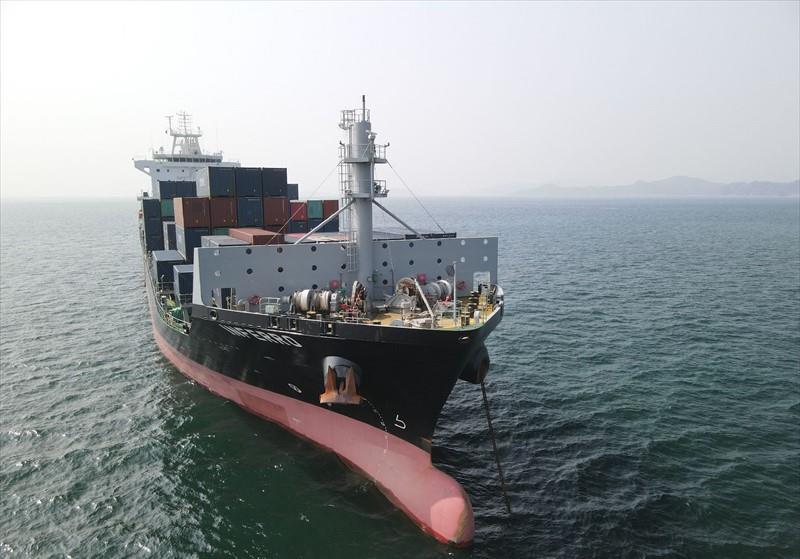
Seven months after a devastating container fire claimed the lives of four seafarers and forced the abandonment of the vessel, Taiwanese shipping company Wan Hai Lines has confirmed the completion of salvage operations for its containership Wan Hai 503. The vessel, built in 2005 and with a capacity of 4,250 TEU, has now been formally delivered for recycling, marking the final chapter of one of the most severe maritime casualties in the Indian Ocean region in recent years.
The incident has once again drawn global attention to the persistent risks associated with container fires at sea, the complexities of salvage operations, and the ongoing debate surrounding ports of refuge for distressed vessels.
A Fire at Sea: The Incident That Shocked the Industry
The fire aboard Wan Hai 503 broke out on June 9, 2025, while the ship was sailing off the western coast of India. Initial reports from the vessel indicated a rapidly escalating emergency, with explosions originating from the forward section of the ship. The exact nature of the cargo involved remains under investigation, but early accounts suggested the presence of dangerous or misdeclared goods, a recurring concern in container shipping accidents worldwide.

As the fire intensified, the situation quickly became unmanageable for the crew. With flames spreading across much of the vessel forward of the deckhouse, and the risk of further explosions increasing, a decision was made to abandon ship.
Evacuation and Human Cost
In a complex and high-risk rescue operation, 18 crewmembers were safely evacuated with the assistance of the Indian Navy and the Indian Coast Guard, whose rapid response proved critical in preventing further loss of life. Six of the rescued seafarers were transported to hospitals with injuries ranging from smoke inhalation to burns and trauma.
Tragically, four crewmembers were reported missing and later confirmed dead, underscoring the deadly nature of shipboard fires and the limited margins for survival once such incidents spiral out of control.
The loss of life cast a long shadow over the incident, prompting renewed calls from maritime unions and safety advocates for stronger enforcement of cargo declaration rules and improved fire detection and suppression systems on containerships.
Weeks of Firefighting at Sea
Following the evacuation, Indian authorities assumed command of the emergency response. Firefighting efforts continued for several weeks, as flames burned across a significant portion of the vessel’s forward sections. The scale of the blaze, compounded by the presence of containers stacked high on deck and in holds, made containment extremely challenging.
Shipboard fires involving containers are notoriously difficult to extinguish due to limited access, heat retention within steel boxes, and uncertainty about cargo contents. In the case of Wan Hai 503, these challenges were magnified by repeated flare-ups and structural damage caused by explosions.
Eventually, the fire was brought under control, but not before rendering the vessel a severely damaged hulk.
The Search for a Port of Refuge
Once the fire was extinguished, attention turned to securing a port of refuge where the ship could be stabilized, inspected, and salvaged. However, this proved to be one of the most controversial phases of the incident.
According to reports, both India and Sri Lanka declined to grant the vessel refuge, citing environmental, safety, and liability concerns. The refusals echoed previous high-profile cases in the region, where distressed vessels were left with limited options due to regulatory uncertainties and fears of pollution.
With no regional port willing to accept the damaged ship, Wan Hai 503 was eventually towed to the United Arab Emirates, arriving in mid-September 2025 after a long and carefully managed tow.

Jebel Ali: A Hub for Complex Salvage
Upon arrival in the UAE, the vessel was granted refuge at the Port of Jebel Ali in Dubai, one of the world’s largest and most advanced ports. After detailed inspections, the ship was berthed to begin what would become a prolonged and technically demanding salvage operation.
Wan Hai reported that 1,696 containers were recovered from the vessel. The majority of these containers had suffered extensive fire damage, particularly those located forward of the deckhouse. Only a limited number of containers stowed near the stern were found to be largely intact.
The ship was operating under a vessel-sharing arrangement, with Hapag-Lloyd also carrying cargo for its customers aboard Wan Hai 503, adding further complexity to claims, investigations, and cargo recovery efforts.
Salvage Challenges: Debris, Water, and Structural Damage
Salvage teams faced formidable obstacles throughout the operation. Large volumes of debris from collapsed containers, twisted steel, and burnt cargo littered the vessel, significantly slowing clearance efforts.
One of the most critical challenges was the removal of firefighting water that had accumulated in the ship’s holds. By late December, Wan Hai confirmed that 11,675 tons of contaminated fire water had been pumped out—a painstaking process essential to restoring buoyancy and ensuring structural stability.
The presence of water not only increased the vessel’s weight but also posed environmental risks, as it contained residues of fuel, chemicals, and burnt cargo materials.
Completion of Clearance and Final Tow
By late December 2025, salvage teams completed the clearance operation. With the ship stabilized and stripped of recoverable materials, the hulk was prepared for its final journey.
The vessel was then towed from Jebel Ali to Drydock World Dubai, where it arrived on January 12, 2026, at a designated berth operated in partnership with APT Global.
Wan Hai emphasized that APT Global operates in compliance with the highest international environmental and safety standards, and that the recycling of Wan Hai 503 will be conducted in accordance with the Hong Kong International Convention for the Safe and Environmentally Sound Recycling of Ships.
Investigations Into the Cause of the Fire
Authorities continue to analyze the cargo manifest, loading plans, and voyage data recorder information to determine the precise cause of the fire. Misdeclared or improperly packed hazardous cargo remains a leading hypothesis, consistent with trends seen in other recent container ship fires.
The findings are expected to contribute to broader industry discussions on cargo transparency, enforcement mechanisms, and liability allocation among shippers, carriers, and freight forwarders.
Wider Implications for Maritime Safety
The Wan Hai 503 incident has had ripple effects across the maritime sector. In the aftermath, India announced efforts to develop enhanced capabilities for granting ports of refuge, recognizing the need for structured frameworks to manage distressed vessels without compromising coastal safety.
The case also drew comparisons with previous incidents, including a Maersk containership fire off India that similarly resulted in the vessel seeking refuge in the UAE, and the infamous X-Press Pearl disaster, where leaking containers led to a catastrophic fire and environmental damage after multiple ports declined assistance.
Together, these incidents highlight a systemic issue: the lack of coordinated international mechanisms to handle maritime casualties in busy and environmentally sensitive regions.
Industry Response and Corporate Statement
In its official statement, Wan Hai expressed “sincere gratitude to all relevant authorities, partners, and professional teams for their invaluable support and collaboration throughout the recovery effort.”
The company acknowledged the complexity and duration of the salvage process, as well as the dedication of salvage crews, port authorities, and emergency responders who worked under difficult and often hazardous conditions.

A Cautionary Tale for the Container Shipping Industry
The loss of Wan Hai 503 serves as a stark reminder of the risks inherent in modern container shipping, where larger vessels, denser cargo loads, and complex supply chains have increased the potential consequences of onboard fires.
As global trade continues to rely heavily on containerized transport, industry stakeholders face mounting pressure to address the root causes of such incidents—through stricter cargo controls, improved fire detection technologies, better crew training, and clearer international rules on ports of refuge.
For the families of the four seafarers who lost their lives, the conclusion of the salvage operation brings a measure of closure, but also a lingering question: whether enough is being done to prevent similar tragedies in the future.