|
Getting your Trinity Audio player ready...
|
After decades of neglect, U.S. shipping and shipbuilding have finally drawn the attention of senior political leaders across two administrations. For the first time in generations, Washington stands on the threshold of a genuine maritime revival. Having shifted course from forty years of stagnation, the United States now faces a historic opportunity to rebuild its maritime power—if it sustains its new bipartisan strategy that links naval strength to commercial vitality and allied cooperation, steering clear of the missteps that once ran America’s seapower aground.
A Forgotten Pillar of Power
History has shown that no great naval power endures without a thriving commercial maritime foundation. Yet since 1981, the United States has tried to defy this law of geopolitics. The Reagan administration’s decision to cut government support for commercial shipping and shipbuilding marked a turning point, setting both sectors on a path of decline and offshoring. Successive leaders convinced themselves that in an era of globalization, America could maintain global dominance at sea without a strong commercial maritime base.
This illusion coincided with another strategic error: the hollowing out of genuine industrial competition. Following the Cold War and the so-called “Last Supper” in 1993, U.S. defense procurement consolidated into monopolies and duopolies, justified by the argument that such concentration would be more efficient than open competition. In practice, this removed innovation, raised costs, and left the defense industrial base brittle.
Three decades later, the results are painfully evident. Skyrocketing costs, chronic delays in Navy shipbuilding, the erosion of the U.S. Merchant Marine, and the inability to recapitalize America’s sealift fleet all trace back to these twin errors. As strategist Colin Gray once warned, tactical and operational mistakes can be fatal in days—but strategic misjudgments take decades to reveal their full devastation. America is now confronting the cumulative consequences of forty years of maritime mismanagement.
China’s Maritime Ascendancy
While America drifted, China was busy building a comprehensive maritime empire. Over the past three decades, Beijing has fused naval expansion with commercial maritime dominance. Its state-backed shipyards and shipping lines—underpinned by control over global logistics, port operations, and maritime finance—now set the terms for much of the world’s trade. The People’s Liberation Army Navy has grown from a coastal defense force into a true blue-water navy, capable of challenging U.S. power projection.
China’s model underscores a truth the United States once understood: naval strength and commercial shipping are inseparable. Beijing’s integration of shipbuilding, logistics, and fleet operations now allows it to wield influence over global commerce in both peace and crisis. America, by contrast, remains seablind—geographically reliant on the world’s oceans but industrially unprepared to command them.
The Emergence of Maritime Statecraft
Recognizing this strategic vulnerability, Secretary of the Navy Carlos Del Toro launched a new vision known as Maritime Statecraft—a holistic strategy to rebuild U.S. seapower by reconnecting the naval, commercial, and industrial pillars of the maritime ecosystem. The premise is simple but revolutionary: naval shipbuilding, commercial shipbuilding, and commercial shipping are not separate issues but interdependent components of one national enterprise.
Maritime Statecraft seeks to revive competition and innovation by bringing world-class allied shipbuilders into the U.S. market. Rather than outsourcing naval production abroad—a political and strategic impossibility—the goal is to bring allied expertise and investment to American shores. This dual-use model, successful in South Korea and Japan, integrates commercial and military shipbuilding in shared facilities, spreading overhead costs, improving efficiency, and sustaining a skilled workforce.
In partnership with Congress and other agencies, the Navy began to restructure support programs for U.S. shipbuilding and shipping—this time framing them not solely as defense imperatives but as instruments of economic security. The result is a comprehensive blueprint to re-create a competitive maritime industry that serves both national prosperity and naval readiness.
The Imbalance of American Seapower
In a healthy maritime nation, the Navy represents only a fraction of the total maritime economy. Civilian shipyards, suppliers, and merchant fleets generate prosperity in peacetime and sustain military capacity in wartime. Yet today, the United States stands as a naval power without a commercial foundation.
The U.S. Navy currently fields fewer than 300 battle-force ships, while the U.S. Merchant Marine counts only 177 internationally trading vessels—out of more than 60,000 on the world’s oceans. America depends on foreign-built, foreign-crewed ships for its own trade, effectively surrendering maritime self-reliance.
This decline began with the 1981 abolition of key subsidy programs that had historically offset the higher costs of U.S. construction and U.S.-flag operations. When Washington unilaterally abandoned these supports, assuming that free-market forces would level the playing field, other nations did not follow suit. Asian and European competitors kept subsidizing their shipyards, and the U.S. industry collapsed.
The Maritime Security Program of the 1990s provided a modest stopgap—keeping a small, mostly foreign-built fleet under U.S. flag for defense use—but it could not replace a vibrant merchant marine or shipbuilding base. Without sustained commercial orders, U.S. shipyards shrank to serve almost exclusively naval customers, leaving the Navy to shoulder all overhead costs and stripping the industrial base of surge capacity.
Monopoly, Stagnation, and the Cost of Complacency
This narrowing of demand coincided with post–Cold War industrial consolidation. Today, nearly every U.S. ship class is built by a single yard, creating monopolies that sap competition and drive costs upward. A handful of firms dominate the naval shipbuilding landscape, with little incentive to innovate or modernize. Facilities dating from the 1960s struggle to produce next-generation warships on schedule, even as executives prioritize dividends and stock buybacks over reinvestment.
By contrast, Asian shipbuilders operate in an unforgiving environment of constant competition. South Korean and Japanese yards battle for global commercial dominance against China’s state-subsidized giants, forcing continuous improvement in efficiency, automation, and design. These nations now produce roughly 90 percent of the world’s commercial ships. Their dual-use shipyards—building both civilian and naval vessels—enable them to deliver high-end warships for a fraction of U.S. costs.
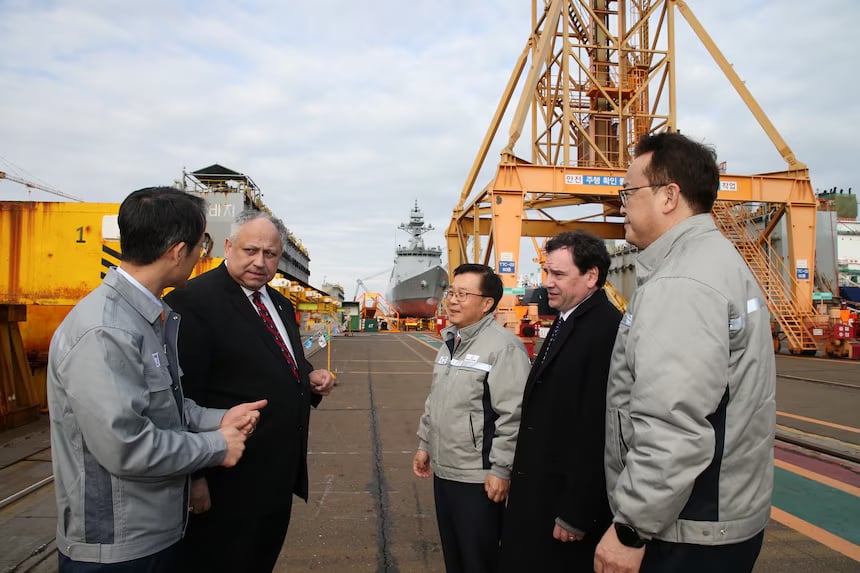
When Secretary Del Toro toured South Korean facilities in early 2024, he observed automation and precision manufacturing far beyond current American practice. Their self-funded investments in workforce housing, training, and technology yield near-perfect delivery records, even amid global disruptions. The comparison exposed just how far U.S. yards have fallen behind.
Outsourcing naval construction to these countries, however, would be strategic folly. Not only does U.S. law require government ships to be built domestically, but the proximity of Asian yards to Chinese missile ranges would make them wartime targets. Instead, the insight behind Maritime Statecraft is this: if America cannot build ships in allied yards abroad, it must bring those yards to America.
Allied Investment: A New Competitive Paradigm
Turning vision into reality began with high-level diplomacy. In February 2024, Secretary Del Toro met with the leadership of South Korea’s Hanwha Ocean and HD Hyundai, encouraging them to invest directly in U.S. shipbuilding. Within months, Hanwha acquired the Philly Shipyard, committing $5 billion to modernize and expand it, adding 7,000 jobs, and restoring its naval capacity after half a century.
HD Hyundai followed with academic partnerships linking Seoul National University and the University of Michigan to train the next generation of naval architects, while exploring acquisitions of its own. Canadian and Finnish firm Davie Shipbuilding soon joined, announcing plans to buy a Texas yard to bring its icebreaker expertise to U.S. programs.
Such partnerships promise to rejuvenate competition, modernize technology, and establish a sustainable dual-use model within the United States. By creating market incentives for both commercial and military production, Maritime Statecraft aims to replicate abroad’s success on American soil.
Financing the Revival
Economic tools are key to this transformation. In 2024, after intensive interagency coordination, the Department of Energy’s Loan Programs Office extended its Title 17 Clean Energy Financing and Advanced Technology Vehicle Manufacturing programs to the maritime sector. These programs now provide Treasury-rate financing for buyers of U.S.-built, energy-efficient ships and for shipyards investing in modernization.
Unions, too, have become essential partners. The United Steelworkers helped trigger a Section 301 investigation into China’s anticompetitive shipbuilding practices, while other labor groups created innovative training pipelines. A partnership with the International Brotherhood of Boilermakers, for instance, recruits skilled construction welders to fill gaps in naval shipyards—an experiment that quickly proved successful and scalable.
Legislatively, Maritime Statecraft shaped the SHIPS for America Act, a bipartisan initiative led by Senators Mark Kelly and Todd Young, and Representatives John Garamendi and Trent Kelly. The bill reintroduces competitive construction differentials and establishes a Strategic Commercial Fleet of 250 U.S.-built, U.S.-flagged vessels in international trade, supported by a new Maritime Trust Fund. Together, these measures would restore demand for U.S. shipyards and incentivize private shipping companies to order domestically built vessels once again.
Engaging Global Shipping Leaders
The next phase involved persuading major global shipowners that reliance on China was a strategic risk. In meetings with European leaders, including Maersk and CMA CGM, the U.S. delegation emphasized that each order placed in Chinese yards strengthens China’s competitive position at their expense. This message resonated. Within months, CMA CGM announced a $20 billion investment in U.S. operations—tripling its U.S.-flag fleet and creating 10,000 American jobs.
Such shifts indicate a growing recognition that maritime dependence on China is unsustainable. By offering a secure, allied alternative for shipbuilding, the United States is beginning to reorient global maritime investment toward its own shores.
Continuity Across Administrations
Remarkably, the Maritime Statecraft strategy has endured the political transition. The incoming administration, including President Trump, Secretary of the Navy John Phelan, and the new White House Office of Shipbuilding, has publicly embraced its framework. The April 2025 executive order on Restoring America’s Maritime Dominance reinforced bipartisan consensus around this maritime revival.
Going forward, Washington must focus on consolidating allied investments—such as Hanwha’s in Philadelphia and CMA CGM’s expansion—while ensuring that Congress funds the Strategic Commercial Fleet and Maritime Trust Fund. The Office of the U.S. Trade Representative must enforce Section 301 remedies on Chinese vessels and direct the proceeds to American shipbuilding capacity.
The upcoming APEC summit in South Korea offers an ideal moment to deepen this cooperation. Seoul’s “Make American Shipbuilding Great Again” initiative and the Korea Development Bank’s $150 billion in shipbuilding financing can translate into real infrastructure and industrial jobs in the U.S. A presidential visit to a Korean shipyard would underscore the partnership’s significance and spotlight the skills America seeks to attract to its revitalized shipyards.
Navigating Risks Ahead
Still, the voyage ahead is not without hazards. The greatest danger lies in political impatience—calls to outsource U.S. government shipbuilding overseas as a shortcut to increasing naval output. Such a move would undermine years of progress, deterring foreign partners from investing in U.S. yards and forfeiting the leverage that drives them to do so.
Another immediate fixable risk is the loophole allowing U.S.-flag vessels subsidized under the Maritime Security Program to undergo maintenance in Chinese shipyards. This practice not only funds China’s maritime ambitions but also exposes vessels supporting U.S. defense logistics to espionage and sabotage.
Longer-term risks stem from inconsistencies in trade, investment, and immigration policies. Heavy-handed enforcement actions—such as the immigration raid at Hyundai Motor’s Georgia plant—send a chilling message to allied investors. The success of Maritime Statecraft depends on America remaining a welcoming and legally predictable environment for allied engineers, managers, and skilled workers.
During negotiations, Korean executives repeatedly asked whether their U.S. subsidiaries would be treated fairly. They were assured that once established in the United States, they would compete on equal terms, enjoying the same access to security clearances and contracts as domestic firms. That assurance was pivotal in unlocking billions in investment.
The U.S. tradition of open, rule-based commerce must therefore continue. In strategic sectors such as shipbuilding, America must not only tolerate but embrace allied participation. The skills, technologies, and investments of partners like South Korea, Japan, Canada, and Finland are essential to America’s maritime renewal.
A New Grand Strategy for the Sea
For too long, leaders across parties neglected the maritime foundation of American power. The result was an aging fleet, a hollowed-out industrial base, and an overreliance on foreign supply chains. Through Maritime Statecraft, the United States is finally confronting this failure with a vision that integrates defense, industry, and diplomacy.
If sustained, this strategy will restore the nation’s maritime independence, revitalize shipbuilding communities, and expand allied cooperation. It will ensure that America once again commands—not just patrols—the seas.
The path forward demands patience, unity, and persistence. The rewards, however, are immense: renewed industrial strength, durable alliances, and a Navy supported by a thriving commercial fleet. The United States has begun to rediscover an old truth—that maritime strategy is grand strategy.