|
Getting your Trinity Audio player ready...
|
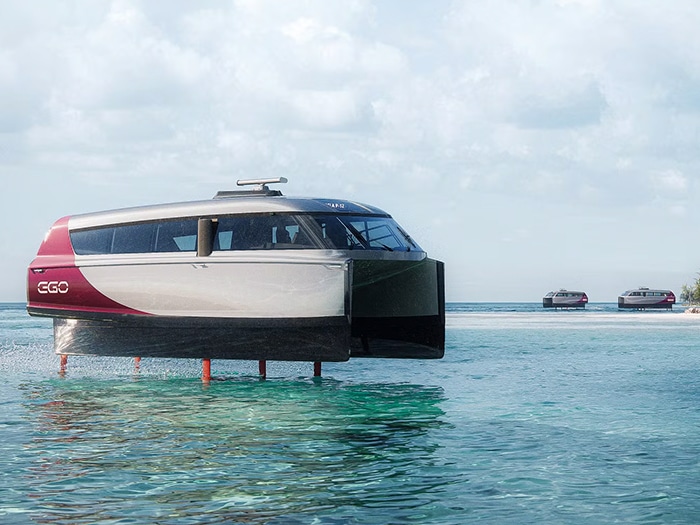
In another major milestone for Sweden’s Candela Technology AB, the Maldives-based operator Ego Shuttle has announced an order for twelve Candela P-12 electric hydrofoil ferries. These state-of-the-art vessels — often referred to as “flying ferries” — are set to revolutionize marine transport in the island nation when they begin operations in 2026, offering travelers a smooth, quiet, and emissions-free journey across the Indian Ocean.
The Maldives, famous for its turquoise waters and luxury resorts, faces a serious environmental dilemma. The country’s tourism industry relies heavily on traditional twin-outboard motorboats to transport visitors between Malé International Airport and the outer island atolls. These boats, while fast and convenient, are among the largest contributors to pollution and carbon emissions in the country. Each conventional speedboat consumes roughly five liters of gasoline per mile, a staggering 15 times more fuel than a typical bus, making them both costly and environmentally damaging.
Beyond fuel consumption, the environmental impact is even deeper. The large wakes generated by traditional boats contribute to coral erosion, while the constant roar of engines disrupts reef ecosystems, interfering with fish reproduction and threatening marine biodiversity. Recognizing these challenges, the Maldives government has prioritized sustainable marine transport as part of its national climate strategy — a goal now within reach thanks to Candela’s pioneering hydrofoil technology.
At the heart of this innovation lies the Candela P-12, a sleek, all-electric vessel that quite literally flies above the water. Using two computer-controlled hydrofoils, the P-12 lifts its hull about 1.5 meters above the sea surface, dramatically reducing drag and energy consumption by up to 80 percent. This radical efficiency allows the vessel to travel long distances at high speeds — something no previous electric boat could achieve.
“Until now, there have been no real options to electrify waterborne transport, as conventional hulls are simply too inefficient to run on battery power,” explains Shabir Walji, CEO of Ego Shuttle. “With the Candela P-12, we finally have a vessel with the range and speed to replace fossil-fuel boats — while minimizing the impact on this unique environment.”
For tourists, the experience promises to be nothing short of transformative. The transfer from the airport to the resort islands has long been considered the least pleasant part of a Maldives vacation — a noisy, bumpy, and often seasickness-inducing ordeal. The P-12, however, changes that entirely. Its advanced hydrofoil system ensures a silky-smooth, stable ride, even in choppy conditions.
The ferry’s onboard Flight Controller, a sophisticated computer system, continuously adjusts the hydrofoils in real time — much like the fly-by-wire systems used in modern fighter jets. This constant micro-adjustment eliminates wave impacts and provides a near-floating sensation for passengers. The result has been described as a “digital pill against seasickness”, providing an unprecedented level of comfort at sea.
Inside, the Candela P-12 offers an airline-like cabin experience, complete with Wi-Fi, entertainment screens, refreshments, wheelchair accessibility, and charging outlets for personal devices. The vessel is designed not just for efficiency, but for elegance — combining Scandinavian design with the tranquility of electric propulsion.
Gustav Hasselskog, founder and CEO of Candela, highlighted the significance of this collaboration:
“It’s simply a better experience. The hydrofoil technology is a win-win — better for passengers and better for the planet. We’re extremely proud to partner with Ego Shuttles to bring our hydrofoil technology to the Maldives, where it will make a lasting impact on one of the world’s most cherished and biodiverse places.”
The first fleet of twelve P-12 vessels will operate between Malé and nearby resort islands, helping to replace the gasoline-powered boats currently in use. Beyond transportation, Ego Shuttle also plans to establish a local logistics and service hub in the Maldives, providing training programs for local workers and creating new green jobs in line with the country’s commitment to sustainable development.
While this marks a first for the Maldives, the Candela P-12 is not an untested prototype. The vessel is already in regular service in Stockholm’s public transport system, where it has been praised for its ability to halve commuting times thanks to speed-limit exemptions granted for low-wake vessels. Passengers in Sweden have reported extremely high satisfaction, citing not only the comfort and quietness but also the futuristic sense of “gliding” across the water.
For the Maldives, the project aligns perfectly with its ambitious climate goals. The island nation has pledged to achieve net-zero emissions by 2030, a bold target for a country that is among the most vulnerable to rising sea levels. Walji notes:
“We’re proud to bring this world-first to the Maldives, supported by the government’s ambitious climate leadership and its commitment to achieving net zero by 2030. Few nations have done more to place sustainability at the heart of development. The Maldives has long been a global voice for climate action, and by adopting the Candela P-12, it shows how even the most vulnerable nations can lead by example.”
Behind the scenes, Candela’s success stems from its in-house innovation ecosystem. Headquartered in Stockholm, Sweden, the company employs more than 200 engineers, technicians, and production experts. Every component — from the C-POD electric motor and control systems to the carbon fiber hulls — is designed and manufactured internally at Candela’s two factories. This full vertical integration allows the company to continuously refine its technology and maintain the highest standards of performance and reliability.
The Candela P-12 project in the Maldives is more than a transport upgrade; it’s a statement of intent — a tangible demonstration that cutting-edge green technology can coexist with luxury tourism, benefiting both people and the planet.
By 2026, when the first ferries take flight over the shimmering waters between Malé and the outer atolls, visitors will not only be traveling to paradise — they’ll be experiencing the future of sustainable marine mobility, one smooth, silent journey at a time.