|
Getting your Trinity Audio player ready...
|
U.S. Customs and Border Protection (CBP) announced the seizure of eight pounds of cocaine from the underwater sections of a cargo ship’s hull as it arrived at PortMiami on September 23. The drugs were retrieved by CBP divers, though officials did not specify whether the ship was chosen for a random inspection or based on a tip-off.
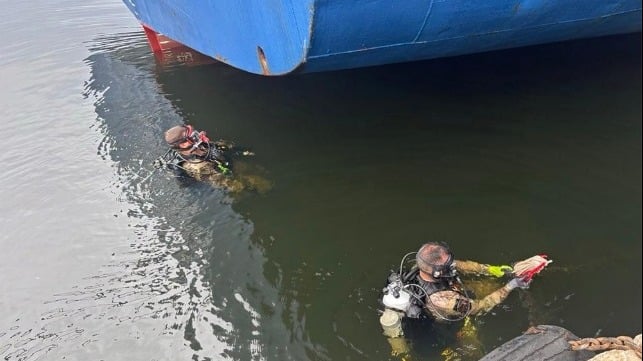
Images shared by CBP showed several divers working around the stern of the vessel. According to the agency, the narcotics were recovered from “deep in the ship’s belly,” a phrase that likely refers to the sea chest. Smugglers have previously used this method, as well as attaching sealed boxes directly to ship hulls, to transport contraband undetected.
The ship in question, the Hoheplate, is an 11,800 dwt containership registered under Antigua and Barbuda. It operates routes throughout the Caribbean. AIS tracking data confirmed that on September 26 the vessel was sailing from the Dominican Republic to Colombia.
CBP reported that its divers employed “specialized underwater cutting tools” to remove the concealed packages. This marks the first “parasitic drug seizure” carried out by the agency’s specialized diving team. Michael W. Banks, Chief of the U.S. Border Patrol, hailed the operation as an innovative step forward in ongoing narcotics interdiction efforts.
Drug smugglers have long exploited commercial ships to move illicit cargo. A notable case occurred in 1990, also at PortMiami, when authorities discovered four steel boxes bolted to the hull of a Carnival Cruise Line vessel. The boxes contained approximately 250 pounds of marijuana, and three individuals were arrested in connection with the attempt.