|
Getting your Trinity Audio player ready...
|
After successfully completing its passage through the Suez Canal, the United Kingdom’s Carrier Strike Group (CSG), led by HMS Prince of Wales (R09), has entered the central Mediterranean Sea to take part in the opening stages of Exercise Falcon Strike 25, a major multinational training event hosted by Italy.
The deployment marks another significant milestone for the Royal Navy’s flagship, as the aircraft carrier embarks on a high-tempo operational phase designed to enhance cooperation with NATO allies and partner nations across the region.
A Changing of Command in Souda Bay
During a scheduled logistics stop at Souda Bay, Crete, the CSG conducted a symbolic handover ceremony in which Captain Will Blackett formally transferred command of HMS Prince of Wales to Captain Ben Power, signaling a new phase in the carrier’s leadership and operational focus.
While alongside, the Type 23 frigate HMS Richmond (F239) carried out joint anti-submarine warfare (ASW) exercises with units from the Hellenic Navy, demonstrating the enduring maritime partnership between the United Kingdom and Greece.
Operating in the Wake of USS Gerald R. Ford
The British carrier group now occupies the same operational sea space recently vacated by the USS Gerald R. Ford (CVN-78), the U.S. Navy’s newest and largest aircraft carrier. The Ford, which transited the Strait of Gibraltar on November 5, is reportedly heading westward toward Venezuelan waters, accompanied by the guided-missile destroyer USS Bainbridge (DDG-96) and the fast combat support ship USNS Supply (T-AOE-6).
However, online maritime trackers and open-source intelligence analysts have noted that Ford appears to be operating off the northwestern coast of Africa, suggesting that her next move remains strategically flexible.
A Multinational Task Force
The UK Carrier Strike Group currently operates as a powerful multinational formation, reflecting the growing emphasis on NATO interoperability and joint readiness. The task force includes:
-
HNoMS Roald Amundsen (F311) – a Norwegian Nansen-class frigate, contributing advanced air-defense and anti-submarine capabilities.
-
HMS Dauntless (D33) – a Type 45 destroyer, providing long-range air and missile defense.
-
HMS Richmond (F239) – a Type 23 frigate, focused on anti-submarine operations.
-
ITS Luigi Rizzo (F595) – an Italian Carlo Bergamini-class frigate, integrating seamlessly with allied command structures.
-
RFA Tideforce (A139) – a Royal Fleet Auxiliary replenishment ship, ensuring sustained operational endurance for the strike group.
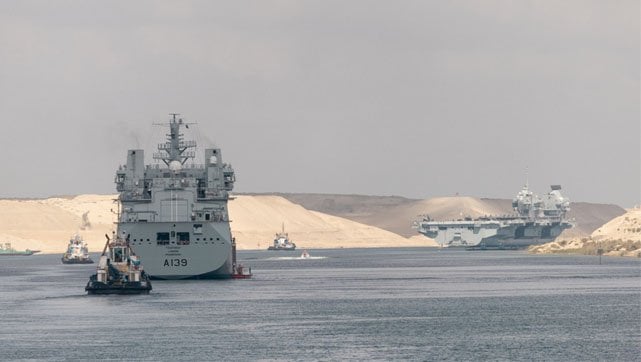
Before the main body of the fleet entered the Mediterranean, RFA Tideforce had already made a logistical transit through the Suez Canal into the Red Sea to position itself for replenishment operations during the CSG’s passage—an indication of the meticulous coordination behind the multinational mission.
Falcon Strike 25: A High-Intensity NATO Air and Sea Exercise
Exercise Falcon Strike 25 is a two-week joint training operation designed to test the interoperability, agility, and combat readiness of allied air and naval forces. The exercise brings together participants from Italy, Greece, Norway, the United Kingdom, and the United States, each contributing both ground-based air units and maritime aviation assets.
For the first time, HMS Prince of Wales will operate with its full complement of F-35B Lightning II aircraft, marking a significant milestone for British naval aviation. These fifth-generation jets will integrate with Italian Navy AV-8B Harrier II aircraft in a complex array of simulated missions, including strike operations, air defense, and maritime interdiction.
This integration of cutting-edge stealth aircraft with traditional carrier-based platforms underscores the Royal Navy’s growing operational maturity with the F-35B program and its ability to project power across the Euro-Mediterranean theater.

Strategic Implications
The Prince of Wales deployment to the Mediterranean comes at a time of heightened global naval activity, as Western forces increase their presence across both the Atlantic and Indo-Pacific regions. The participation of multiple NATO members in Falcon Strike 25 demonstrates a clear commitment to collective defense, joint training, and maritime security cooperation.
Moreover, the seamless coordination between the British, Norwegian, Greek, Italian, and U.S. naval forces reinforces NATO’s ability to conduct complex operations under a unified command structure — a message of cohesion and deterrence at a time of shifting geopolitical dynamics.
Looking Ahead
As Exercise Falcon Strike 25 unfolds, HMS Prince of Wales and her strike group are expected to engage in a wide spectrum of operations, from carrier strike sorties and anti-submarine warfare drills to amphibious coordination with ground-based air units.
The carrier’s deployment also continues to symbolize the Royal Navy’s intent to maintain a persistent global presence, working alongside allies to safeguard vital sea lanes and ensure freedom of navigation across strategic chokepoints, from the Suez Canal to the Gibraltar Strait.
With Captain Ben Power now at the helm and a full strike wing of F-35B aircraft embarked, HMS Prince of Wales is entering the next phase of her operational development — one that reaffirms Britain’s position at the forefront of modern carrier aviation and multinational defense cooperation in the 21st century.