|
Getting your Trinity Audio player ready...
|
In a development that has reignited concerns over maritime security in one of the world’s most sensitive waterways, independent security specialists at EOS Risk Group have confirmed that Iran has seized a foreign-flagged tanker in the Gulf of Oman—the first such incident in more than a year. According to EOS analyst Martin Kelly, the Marshall Islands–flagged crude oil carrier Talara (IMO 9569994) was intercepted roughly 20 nautical miles off the coast of the United Arab Emirates, in waters commonly transited by vessels heading toward or emerging from the Strait of Hormuz.
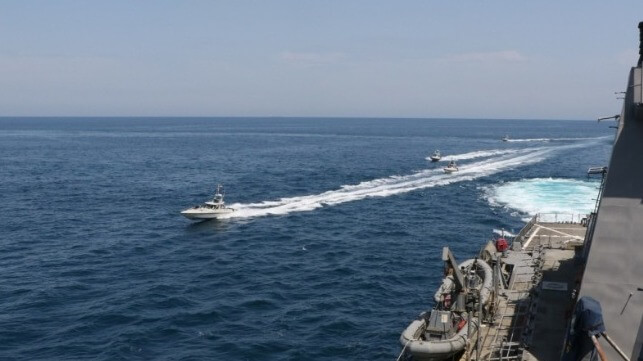
Early reports suggest that the Islamic Revolutionary Guard Corps’ naval arm executed the operation. Security firm Ambrey told the Associated Press that three small craft approached Talara, deployed a boarding team, and gained control of the vessel. The events unfolded in an area that is both strategically vital and heavily surveilled due to its status as a key chokepoint for global energy flows. Flight-tracking data cited by the AP indicated that a U.S. Navy long-range surveillance drone circled the location for several hours after the incident, underscoring the heightened attention Western militaries give to maritime activity in the region.
Talara is a 73,000-dwt crude oil tanker built in 2010 and registered under the Marshall Islands flag, a registry administered by an American-based authority. The vessel is managed by Columbia Shipmanagement, a Cyprus-based third-party operator, though the identity of the ultimate beneficial owner remains unclear. In a public statement, Columbia confirmed that it had lost communication with the crew and was actively working to restore contact. “The safety of the crew remains our foremost priority,” the company emphasized.
The seizure fits a longstanding pattern of Iranian maritime interventions targeting Western-linked commercial shipping. Over several decades—and particularly since the so-called “Tanker War” of the late 1980s—Iran has intermittently detained vessels transiting the Strait of Hormuz and adjacent waters. While Iranian officials typically frame these actions as lawful enforcement operations, analysts note that many occur outside Iran’s recognized maritime jurisdiction and appear closely tied to broader geopolitical considerations or moments of heightened regional tension.
The last comparable event occurred in early 2024, when Iranian forces seized the container vessel MSC Aries. While the multinational crew was released within weeks, Iran retained control of the ship for an extended period, reinforcing concerns among shipping operators and insurers about the unpredictability of transits through this critical corridor.
The latest incident involving Talara has once again highlighted the fragility of maritime security in the Gulf of Oman and raised questions about potential repercussions for global energy transport, regional stability, and diplomatic efforts aimed at easing tensions. As investigations continue, shipping stakeholders are awaiting further information on the status of the tanker’s crew, the motivations behind the seizure, and the prospects for a swift resolution.