|
Getting your Trinity Audio player ready...
|
Reports circulating online have sparked widespread speculation after photos and videos surfaced allegedly showing a Russian warship engulfed in flames while docked at Sevastopol, the main naval base in Crimea. Although Russian authorities have yet to confirm the incident or release any official statement, the event marks the latest in a troubling series of mishaps and attacks affecting the Russian fleet stationed in the Black Sea.
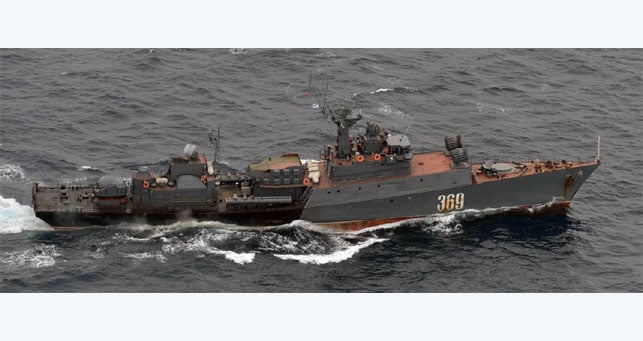
The independent monitoring platform Crimea Wind was the first to publish images and videos showing thick plumes of smoke rising from the naval dock area near Sevastopol. Initially, observers struggled to determine which specific vessel was burning, as camouflage netting obscured much of the ship’s superstructure. Later updates suggested that the damaged vessel belonged to Russia’s Project 1124-M class — a small anti-submarine corvette that has been in service for decades.
A Vessel from an Aging Fleet
Project 1124-M corvettes, also known by their NATO reporting name Grisha-class, were originally built between the mid-1960s and the late 1980s. These vessels, roughly 72 meters (235 feet) long and displacing about 1,000 tons, were designed primarily for coastal patrol duties and anti-submarine warfare. While small by modern naval standards, they remain an important part of Russia’s maritime security infrastructure, particularly in the Black Sea region.
The smoke from the Sevastopol fire was first observed on November 3, with local sources indicating that the blaze may have continued for several hours or even days. No casualties or official explanations have been provided so far, and the Russian Ministry of Defense has remained silent on the matter.
A String of Accidents and Attacks
The Sevastopol fire comes amid a wave of mysterious incidents and reported sabotage efforts targeting Russia’s naval capabilities. The Kyiv Post noted that the Russian Navy has faced a series of setbacks over the past year — both from Ukrainian strikes and from unexplained accidents within its shipyards.
Just a week before the fire, a massive floating crane reportedly capsized at the Sevastopol shipyard, killing two workers and injuring more than twenty others. Russian officials quickly launched a criminal investigation into the accident but offered no further details.
Earlier this year, Ukraine claimed responsibility for successful attacks on several Russian warships, including the reconnaissance ship Ivan Khurs and the amphibious assault vessel Caesar Kunikov. Both ships suffered significant damage in targeted drone and missile operations carried out by Ukrainian forces.
Shifting Strategy in the Black Sea
Analysts suggest that the growing vulnerability of the Russian Black Sea Fleet has forced Moscow to alter its maritime strategy. Ukrainian intelligence officials told the Kyiv Post that Russian vessels are increasingly avoiding open waters due to the high risk of drone and missile strikes.
Where once Russian warships patrolled aggressively across the Black Sea, many now remain moored in ports such as Sevastopol and Novorossiysk. In 2024, two of the Project 1124-M corvettes stationed in Sevastopol were reportedly redeployed to Novorossiysk in an effort to safeguard them from potential Ukrainian attacks.
Silence from Moscow
Despite mounting evidence and viral footage, Russian state media has yet to acknowledge the latest fire. The Ministry of Defense and local authorities have issued no statements, maintaining a consistent policy of silence on incidents that could be perceived as signs of weakness or vulnerability.
Independent analysts believe that the continuing series of fires, accidents, and attacks reflect both logistical strain and declining morale within Russia’s Black Sea Fleet. “These incidents — whether sabotage, operational error, or simple neglect — show that the fleet is under sustained pressure,” one maritime expert noted.
As the conflict between Russia and Ukraine grinds on, the strategic waters of the Black Sea continue to serve as a volatile theater of confrontation. The fire in Sevastopol may be just another episode in a long line of events that underscore the growing challenges facing Russia’s once-formidable naval presence in the region.