|
Getting your Trinity Audio player ready...
|
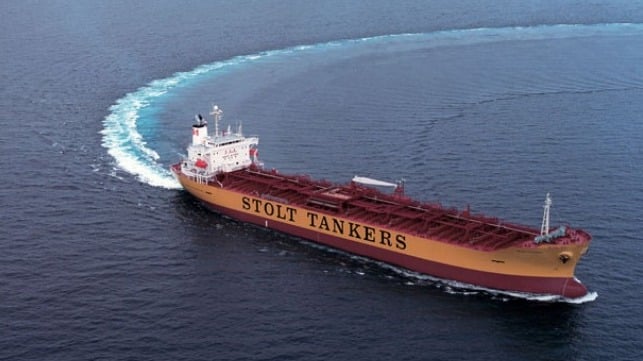
A Stolt Tankers-operated vessel sailing off the coast of Somalia has reported gunfire and a suspected boarding attempt, raising renewed concerns over a resurgence of piracy in one of the world’s most notorious maritime danger zones.
According to multiple maritime security consultancies, later corroborated by Stolt Tankers and both UK and EU naval forces, the product tanker Stolt Sagaland (44,000 dwt) came under threat on Monday, November 3, while transiting approximately 330 nautical miles southeast of Mogadishu, Somalia. The 182-meter vessel, built in 2008 and registered in the Cayman Islands, was en route from Saudi Arabia to Africa when it was approached by a small craft carrying four armed individuals.
Reports from the ship’s master indicate that the assailants, believed to be attempting a boarding, fired several rounds—apparently from AK-47-type rifles. The Stolt Sagaland immediately increased speed and executed evasive maneuvers while the onboard private security team returned fire. The small boat eventually disengaged, and the tanker continued its voyage. No injuries were reported among the crew.
The United Kingdom Maritime Trade Operations (UKMTO) had issued a security alert just days earlier, warning vessels to exercise heightened caution due to escalating suspicious activity off Somalia’s coastline.
Recent reports suggest that two dhows were approached in the same region last week, with one allegedly hijacked—either in an armed robbery or for use as a “mother ship.” The dhow, flagged in Iran, was said to have a crew of 19.
Adding to the growing concern, EUNAVFOR Atalanta confirmed on November 3 that three separate incidents were recorded within the previous 24 hours in waters off Mogadishu.
The first incident, on November 2, involved a 3,500-dwt fishing vessel registered in the Seychelles. A high-speed skiff approached from the stern, prompting the crew to issue a “warning burst.” The skiff retreated toward a suspected mother ship.
About four hours later, the Norwegian-flagged bulker Spar Apus (63,271 dwt), sailing from Qatar to Brazil, reported that a small boat traveling at about 15 knots approached without identification signals or radio response. The bulker accelerated and altered course, successfully evading the craft.
A third approach, recorded early on November 3, occurred roughly 33 nautical miles from shore, with the previous two incidents reported 360 and 446 nautical miles offshore, respectively—suggesting a wide operating range by suspected pirate groups.
The tactics, distances, and reported use of mother ships all mirror the operational patterns of Somali pirate networks that terrorized the region’s shipping lanes in the late 2000s and early 2010s. Authorities now warn that at least one active pirate group may still be operating from a mother vessel in the area.
While smaller attacks on fishing boats have persisted, this is the first assault on a large commercial vessel since May 2024. Somali piracy had largely declined in recent years due to international naval patrols and industry-led security measures. However, maritime experts fear a revival of organized attacks—particularly amid broader regional instability and following the Houthi militant assaults on shipping in the Red Sea and Gulf of Aden since 2023.
The latest events underscore the fragile security situation along East Africa’s vital sea lanes—reminding the global maritime community that the threat of Somali piracy, though diminished, has never entirely disappeared.