|
Getting your Trinity Audio player ready...
|
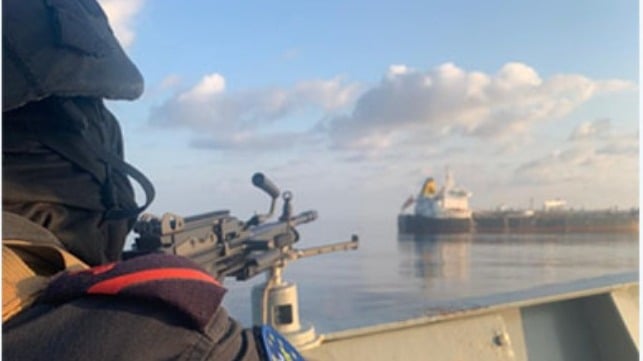
The Greek-owned product tanker Hellas Aphrodite was freed on the afternoon of November 7, more than 24 hours after pirates boarded the vessel off Somalia’s coast. EUNAVFOR Operation Atalanta confirmed that all 24 crew members were safe, having secured themselves in the ship’s citadel during the ordeal. The Spanish Navy frigate ESPS Victoria stood by the tanker as it prepared to resume its voyage.
The hijacking occurred on November 6, approximately 560 nautical miles southeast of Eyl, Somalia. The vessel’s master reported that the pirates fired small arms and rocket-propelled grenades (RPGs) before boarding the gasoline-laden tanker. The multinational crew, which includes a Montenegrin master along with Greek and Filipino seafarers, managed to barricade themselves in the citadel for the duration of the attack.
EUNAVFOR reported that the ESPS Victoria—a 3,160-ton frigate commissioned in 1987—was on patrol nearby and was immediately deployed to the scene. “After an early show of force, the Pirate Action Group abandoned the merchant tanker,” Atalanta stated. The frigate utilized its helicopter, uncrewed aerial vehicle, and Special Operations team, supported by reconnaissance aircraft.
Atalanta coordinated a joint response that involved authorities in Somalia’s Puntland region, a Japanese P-3C maritime patrol aircraft, a Seychelles reconnaissance plane, and Spain’s Joint Operations Command. Communication was maintained with the crew, the vessel’s flag state, and the shipowner throughout the incident.

According to Atalanta, the pirates used a dhow as a mothership, allowing them to operate farther offshore. Both EUNAVFOR and the UK Maritime Trade Operations (UKMTO) have warned that the threat level in the region remains high. Martin Kelly, Head of Advisory at EOS Risk Group, noted that the Hellas Aphrodite attack was the third in a series of incidents linked to the same pirate group.
While the Hellas Aphrodite was being secured, another attempted attack occurred. A skiff carrying three armed men approached the Marshall Islands-flagged LNG carrier Al Thumama (113,749 dwt) about 120 nautical miles north of the earlier incident. The LNG carrier, sailing from Qatar to Poland, managed to evade the assailants by increasing speed.
Atalanta revealed that a coordinated mission is underway to intercept the dhow believed to serve as the pirates’ mothership. The vessel is reportedly the Iranian-flagged Issamohamadi 2, hijacked earlier this month. Data gathered from the Hellas Aphrodite will aid in identifying and prosecuting the pirates. Intensive aerial and naval searches continue across the region to locate the group.
The same pirate cell is suspected in multiple recent incidents. On November 2, the Seychelles-flagged fishing vessel Intertuna Tres came under approach but repelled the attackers with warning shots. That day, the Norwegian bulker Spar Apus also encountered a suspicious skiff traveling at high speed and altered course to avoid contact.
On November 3, the product tanker Stolt Sagaland reported being fired upon. Its onboard security team returned fire, forcing the assailants to flee back to their mothership.
EUNAVFOR has since issued a formal Threat Bulletin advising commercial vessels to steer clear of the affected region whenever possible. UKMTO is briefing ships in Dubai and regional shipping operators to register transits and implement enhanced protection measures when passing near Somali waters.
Analysts warn that these incidents mark the most serious wave of Somali piracy in 18 months. While sporadic robberies of fishing vessels and dhows have persisted, the recent surge against large merchant ships—following the brief hijacking of a Chinese fishing vessel in December 2024—has reignited fears of a renewed piracy resurgence across the western Indian Ocean.