|
Getting your Trinity Audio player ready...
|
In a concerning escalation of piracy off the Horn of Africa, the Greek-owned product tanker Hellas Aphrodite has reportedly been attacked and boarded by armed assailants off the coast of Somalia. The incident, which unfolded on the morning of November 6, marks the most serious act of piracy in the region in over a year and a half, reigniting fears of a resurgence in Somali maritime attacks.
According to a statement from Latsco Shipping, the vessel’s manager, all 24 crew members have been accounted for and are currently sheltering in the ship’s citadel—a fortified safe room used in pirate emergencies. Communication with the crew has been maintained, and the situation is being closely monitored as international naval forces move to intervene.
The Attack: A Coordinated Assault in the Open Sea
The Hellas Aphrodite, a 49,992-deadweight-ton product tanker flying the Maltese flag, was sailing approximately 550 nautical miles off Mogadishu when it was approached by a small craft. The tanker, which had departed India bound for South Africa carrying gasoline, attempted to evade the attackers through speed and defensive maneuvers. However, the pirates, reportedly armed with small weapons and rocket-propelled grenades (RPGs), managed to reach the vessel and board it after an exchange of gunfire.
UK Maritime Trade Operations (UKMTO) confirmed that the ship’s master sent out distress messages during the assault, reporting small arms fire and several RPG rounds directed at the vessel. The Hellas Aphrodite was not carrying armed guards—a detail analysts suggest may have emboldened the attackers.
Naval Forces Mobilize: Operation Atalanta Responds
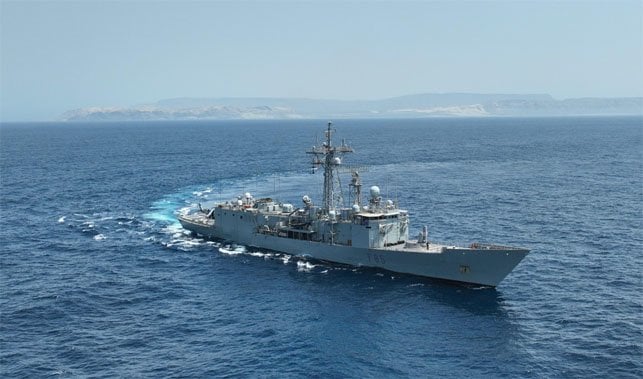
EUNAVFOR’s Operation Atalanta, the European Union’s long-standing anti-piracy mission in the region, announced that one of its frigates was on patrol nearby and is currently en route to assist the tanker. “The warship is closing the distance and is ready to take appropriate action,” a spokesperson for Atalanta stated.
Naval sources indicate that this attack may be linked to a known pirate group operating in the area, believed to be using a captured Iranian dhow named Issamohahmdi as a mothership. The dhow, one of two hijacked last weekend, has not yet been recovered and may be serving as the pirates’ mobile base.
Warning Signs Ignored: Growing Pirate Activity Beyond the Danger Zone
The latest assault took place further offshore than typical Somali pirate operations—roughly 550 miles from the coast—raising alarms among maritime security analysts. Traditionally, piracy in this region has been concentrated closer to the Somali coastline, but the use of larger motherships now allows pirate groups to operate across a much wider range.
Just three days earlier, on November 3, the chemical tanker Stolt Sagaland was approached in a similar incident. Armed guards aboard that vessel fired back at the attackers, forcing them to retreat without boarding.
Maritime security experts had already cautioned that at least one organized pirate cell remained active in the western Indian Ocean. This group appears to have regrouped and adapted its tactics amid the shifting dynamics of regional conflicts and reduced international patrol presence.
A Resurgent Threat Amid Regional Instability
The reemergence of Somali piracy comes nearly two years after it was believed to be under control. The first signs of renewed pirate activity surfaced in November 2023, coinciding with the start of Houthi rebel disruptions in the Red Sea. During that period, Somali pirates managed to hijack a bulk carrier before being intercepted by the Indian Navy in a daring rescue operation in December 2023.
While international naval efforts and local coast guard cooperation significantly reduced piracy incidents in the mid-2010s, experts warn that underlying economic and political instability in Somalia continues to fuel recruitment into pirate networks. These groups often rely on hijacked vessels and ransom payments to sustain operations.
The last major attack on a large commercial ship in the region occurred in May 2024, though sporadic incidents involving fishing boats and smaller cargo vessels have persisted. Several Chinese and Indian fishing vessels have been harassed, boarded, or robbed in recent months, suggesting that the pirates are widening their targets once again.
Growing Concern Among Shipowners and Maritime Authorities
Global shipping associations and insurers are expressing concern that this latest incident could signal a dangerous uptick in long-range piracy. The International Maritime Bureau (IMB) has repeatedly warned that reduced vigilance—due to a period of relative calm—could make commercial shipping more vulnerable.
The Hellas Aphrodite incident has already prompted renewed advisories urging vessels transiting the Indian Ocean and Gulf of Aden to adopt heightened security measures, maintain strict lookout procedures, and report suspicious activities to naval coordination centers.
As of the latest updates, the Hellas Aphrodite remains under pirate control with its crew secured inside the citadel. Naval forces from Operation Atalanta are closing in on the scene, and a multinational response is expected to unfold over the coming hours.
The attack stands as a stark reminder that, despite years of relative quiet, piracy off the coast of Somalia remains a latent threat—one capable of resurfacing with deadly precision when international vigilance wanes.