|
Getting your Trinity Audio player ready...
|
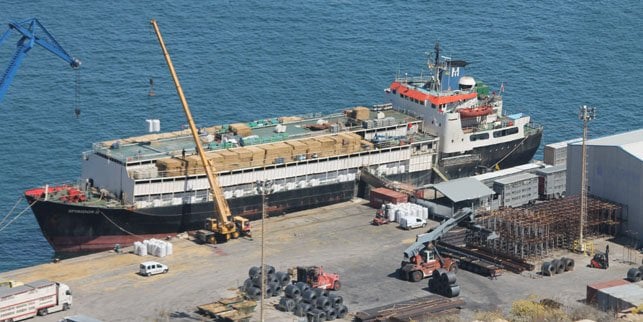
For more than two weeks, a livestock carrier has remained stranded off the Turkish coast amid growing outrage from residents and animal rights organizations. Officials continue to block the offloading of thousands of cattle aboard the Spiridon II, citing irregularities in the animals’ documentation, while conditions on board are reportedly deteriorating rapidly.
The Spiridon II, a 97-meter livestock carrier built in 1973 and converted in 2011, departed Uruguay on September 19 carrying 2,901 cattle bound for Turkey. When the vessel arrived at Bandırma Port on October 22, inspectors from Turkey’s Ministry of Agriculture and Forestry found discrepancies in roughly 500 of the animals’ ear tags. The mismatched documentation prompted authorities to deny the ship permission to unload its cargo, leaving the animals confined in stifling, unsanitary conditions.
Residents living near Bandırma Port soon began complaining of strong odors and swarms of flies, prompting officials to move the vessel to an offshore anchorage. The government also ordered additional pesticide spraying in the area.
According to the vessel’s owner, at least 48 animals have died since the ship’s arrival. The company has requested permission to dock temporarily on November 8 to load vital supplies—two trucks of hay, two of feed, and water—but authorities have yet to confirm whether this will be allowed. Activists also fear that carcasses may have been dumped at sea, although there has been no official comment on the disposal of the dead cattle.
Animal welfare organizations—including the Animal Welfare Foundation (AWF), Animal Advocacy and Food Transition, Animals International, and maritime veterinarian Dr. Lynn Simpson—are urgently calling on Turkish authorities to allow the immediate unloading of the surviving animals.
“These animals are trapped in desperate conditions,” said Dr. Maria Boada Saña, a veterinarian with the AWF. “After such a long journey, these cattle are exhausted, dehydrated, and in urgent need of care. Every additional day at sea means further suffering.”
The AWF and its partner groups argue that bureaucratic delays are costing animal lives and urge the Turkish government to “prioritize the animals’ survival over paperwork.”
The Spiridon II, registered under the Togolese flag and managed from Lebanon, has a troubled history. In June 2022, the ship suffered an engine failure off the coast of Spain while transporting approximately 7,900 bulls and sheep. The vessel was later towed to Greece, where the livestock had to be transferred to another carrier at anchor. The ship is not licensed to operate within the European Union due to its condition and animal welfare concerns.
The incident has reignited debate over the ethics of live animal exports, a practice long criticized by activists as cruel and outdated. Several countries—including Australia and New Zealand—have banned the sea transport of live animals, citing welfare concerns. However, the trade continues elsewhere; in early 2025, Argentina controversially lifted its 52-year ban on live cattle exports.
Industry observers note that the few companies still active in this trade often operate older vessels converted from other uses. One of the largest former players, Australia’s Wellard, sold its final livestock ship and exited the business entirely at the start of 2025.
As the Spiridon II remains anchored offshore and supplies dwindle, animal welfare advocates warn that every additional day without action risks turning the vessel into a “floating graveyard.”