|
Getting your Trinity Audio player ready...
|
For decades, pyrotechnic flares have been the default distress signaling method aboard commercial vessels. Yet, in an era when ships are equipped with advanced, satellite-connected safety systems, their continued use seems increasingly outdated. Chris Hoffman, Director of Technology Strategy at ACR Electronics, highlights the mounting evidence and industry calls urging regulators to recognize electronic Visual Distress Signaling Devices (eVDSDs) as the safer, more sustainable replacement for pyrotechnic flares.
The Hidden Risks of Pyrotechnic Flares
Traditional flares have long posed safety, environmental, and logistical challenges. In an emergency, a crew member must open the flare pack, ignite it, and hold it overboard — all while avoiding burns or setting the liferaft ablaze. Pyrotechnic flares burn at temperatures exceeding 1,000°C, producing molten residue, smoke, and sparks that can endanger users and equipment.
Beyond immediate safety concerns, their chemical composition presents a toxic legacy. Many red handheld and rocket flares contain strontium nitrate and other hazardous compounds that are environmentally persistent and harmful. Once expired — typically after just three years — they become classified hazardous waste, requiring specialist disposal.
Storage and transportation are equally problematic. Because they contain explosives, flares are categorized as Class 1 dangerous goods, making shipping expensive and heavily regulated. Reliability is another issue: flares can fail to ignite due to dampness, poor storage, or damage, and in rare cases, can even explode during use. When they do function properly, their bright signal lasts only seconds.
A Modern Safety Network
Today’s commercial vessels already carry a suite of advanced alerting and locating systems that far surpass the capability of traditional flares. Emergency Position Indicating Radio Beacons (EPIRBs) connect with satellite networks such as Cospas-Sarsat, GPS, and Galileo to transmit distress signals and coordinates directly to rescue centers. Automatic Identification System (AIS) transponders continuously broadcast vessel data to nearby ships. Digital Selective Calling (DSC) radios, part of the GMDSS framework, provide location-enabled voice communication, while Survival Craft VHF radios enable contact from liferafts. Search and Rescue Transponders (SARTs) — both radar and AIS versions — allow rescuers to pinpoint survivors with precision.
Given this extensive digital safety network, reliance on flares that burn for mere moments feels increasingly unnecessary.
Electronic Flares: The Next Generation of Distress Signaling
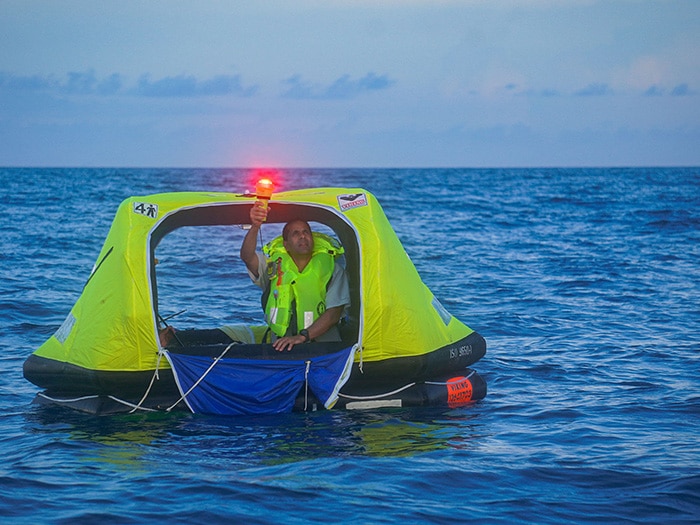
Electronic Visual Distress Signaling Devices (eVDSDs) — or electronic flares — are compact, rugged, and waterproof. They emit bright, flashing LED patterns visible for several miles and often feature infrared strobes for enhanced visibility at night or in poor conditions. Crucially, they can operate continuously for hours — sometimes an entire night — without risk of fire or chemical exposure.
Unlike pyrotechnic flares, electronic models can be safely tested, reused, recharged, or fitted with fresh batteries. They do not expire, emit no toxic byproducts, and pose zero burn or explosion risk.
While pyrotechnic flares remain brighter in absolute terms, brightness alone is no longer a decisive advantage. When integrated with modern positioning and communication systems, eVDSDs provide sufficient visibility to guide rescuers — without any of the hazards of traditional flares.
Regulatory Progress and the Road Ahead
Encouragingly, the transition away from pyrotechnics is already gaining momentum. The Radio Technical Commission for Maritime Services (RTCM) has introduced a performance standard for eVDSDs, and the U.S. Coast Guard’s approval of these devices for recreational vessels marks a significant milestone. Manufacturers across Europe and Asia are now developing multi-color strobes and AIS-integrated electronic flares to expand their functionality and compliance readiness.
For international regulators such as the International Maritime Organization (IMO) and the UK’s Maritime and Coastguard Agency (MCA), the path forward is clear: approve eVDSDs as equivalent carriage options for commercial vessels, and set a timeline to phase out pyrotechnic flares altogether.
By doing so, regulators would not only enhance maritime safety but also reduce environmental harm and logistical burdens. Most importantly, they would signal the maritime industry’s readiness to embrace a cleaner, smarter, and safer future — one where distress signaling finally matches the technological sophistication of modern seafaring.