|
Getting your Trinity Audio player ready...
|
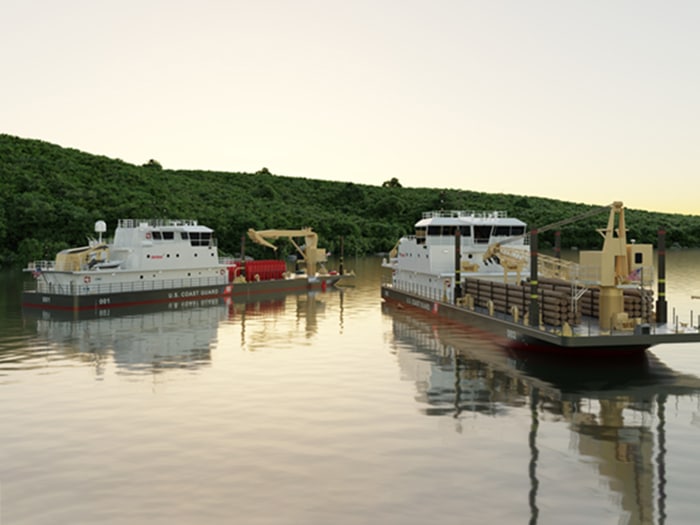
The U.S. Coast Guard is pressing ahead with its Waterways Commerce Cutter (WCC) program, awarding contracts for the production of the first river buoy tender (WLR) and long-lead materials for the second inland construction tender (WLIC). The vessels will be built at Birdon America Inc.’s shipyard in Bayou La Batre, Alabama.
As part of the order, the Coast Guard also secured three sets of long-lead time material (LLTM) to support future production. The combined value of the production and LLTM orders is approximately $110 million. Funding includes $51 million provided under Public Law 119-21—the One Big Beautiful Bill Act—which covers the second WLIC and two LLTM sets. The remaining balance comes from regular appropriations.
“Our nation’s marine transportation system facilitates over $5.4 trillion in economic activity every year and supports millions of jobs throughout the United States,” said Rear Adm. Mike Campbell, the Coast Guard’s Director of Systems Integration and Chief Acquisition Officer. “Placing these new cutters on contract ensures we have the capabilities necessary to keep commerce moving safely and efficiently on our inland waterways.”
The new WLICs will handle construction, repair, and maintenance of fixed aids to navigation (AtoN) along the Eastern Seaboard and Gulf Coast. They are uniquely equipped to drive and remove piles, erect towers, and execute major structural work—making them the Coast Guard’s only platform with such capabilities. Construction of the first WLIC, ordered in June 2025, is expected to be completed in 2027.
The WLRs, meanwhile, will operate on the Western Rivers, setting, relocating, and recovering buoys that guide vessels through shifting channels as water levels fluctuate. They will also establish and maintain fixed aids, lights, and daybeacons. The first WLR is likewise projected for completion in 2027.
Both the WLICs and WLRs are being acquired under the same contract due to their shared design features.
The WCC fleet will replace the aging inland tender fleet, which has an average age of nearly 60 years, with some vessels still in operation after more than eight decades. Today, this fleet is responsible for maintaining over 28,200 marine aids across 12,000 miles of inland waterways, supporting the movement of roughly 630 million tons of cargo annually.