|
Getting your Trinity Audio player ready...
|
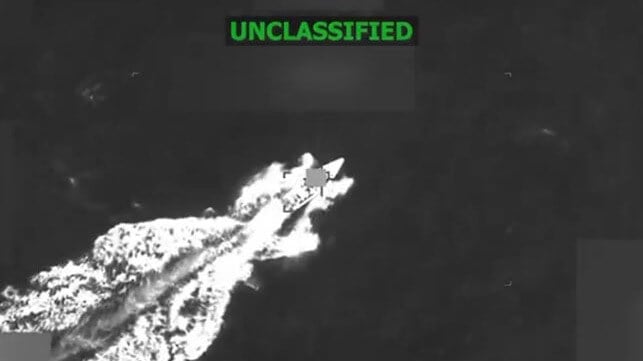
In a move that continues to draw both domestic and international attention, the United States on Friday, November 7, confirmed its latest military strike on a small vessel in the Caribbean believed to be engaged in drug smuggling. The action marks the 17th such strike since the campaign began, with growing concern that this aggressive anti-narcotics operation could have unintended consequences for commercial shipping and regional stability.
According to the announcement posted online by Pete Hegseth, a key figure promoting the policy, “three male narco-terrorists were killed” in the most recent operation. Hegseth maintains that these vessels are operated by what he called a “Designated Terrorist Organization,” insisting that the strikes will persist “until the groups stop smuggling drugs into the United States.”
A Campaign Marked by Controversy and Casualties
By current counts, the U.S. has now destroyed 17 boats and one semi-submersible vessel in the Caribbean and surrounding waters. The estimated death toll has reached 69 to 70 individuals, with only a handful—two or three at most—reported to have survived the initial assaults. The U.S. government argues that these lethal actions are necessary to deter narcotics smuggling into American ports, but the lack of transparency surrounding intelligence sources and target selection has fueled sharp criticism.
A recent Associated Press investigation has cast doubt on the administration’s depiction of the victims as hardened “narco-terrorists.” After conducting interviews in Venezuela with relatives and acquaintances of nine of the deceased, the AP concluded that most were low-level operators rather than cartel leaders or members of terrorist networks. Many were first-time or second-time crew members—ordinary citizens such as fishermen, taxi drivers, and laborers lured by the promise of quick pay. The report paints a troubling picture of vulnerable individuals caught between poverty and the U.S. war on drugs.
Commercial Shipping Faces Rising Risks
The growing militarization of anti-narcotics efforts has raised alarms across the global maritime sector. Gard, one of the world’s leading marine and energy insurance providers, has issued a detailed advisory warning that the current U.S. strategy may push traffickers toward using commercial ships—often without the knowledge of their owners or crews.
“Use of the military against suspected drug smuggling boats by the current U.S. administration may also push more activity toward commercial vessels,” Gard cautioned. The insurer notes that the high-risk zones for cocaine trafficking remain concentrated around Colombia, Ecuador, Peru, Mexico, Brazil, and Venezuela, but that “patterns may change due to increased pressure by law enforcement, both in countries of production and countries where the drugs are found.”
Gard’s senior loss prevention specialists have released a comprehensive report on the consequences of cocaine smuggling for the maritime industry. Their analysis underscores that “rising cocaine production and evolving trafficking routes are creating serious risks for commercial vessels.” The report details cases where traffickers infiltrated legitimate ports, posing as terminal staff or stevedores, and even instances where rogue employees helped conceal narcotics aboard unsuspecting merchant ships.
In Europe, authorities have repeatedly warned that drug cartels have managed to infiltrate major ports, further complicating enforcement. Gard emphasizes that while only a small number of drug discoveries occur on board or attached to vessels, the reputational and legal risks to shipowners and crews are significant. When narcotics are discovered in containers or cargo holds, crews can face prolonged detentions, criminal investigations, and loss of income—even when completely uninvolved.
Record Seizures, Limited Results
The U.S. Coast Guard recently announced a record-breaking year for cocaine seizures, highlighting the scale of its interdiction patrols across both the Caribbean and Pacific. The Coast Guard’s operations typically involve intercepting drug boats, arresting the crews, and handing them over for prosecution in the United States or partner nations.
However, critics argue that these record numbers mask the deeper ineffectiveness of the long-standing war on drugs. Despite billions spent annually on interdiction, experts note that the flow of cocaine and other narcotics continues largely unabated. Many analysts emphasize that the strikes destroy only a fraction of the overall supply chain and fail to address the root causes of addiction and demand within the United States.
“Destroying small boats does not stop the flow—it only shifts the routes,” said one maritime security analyst. “Without addressing domestic consumption, these efforts are like cutting the branches of a tree while the roots remain intact.”
https://x.com/SecWar/status/1986631797547921741?s=20
Political Tensions and Legal Questions
Within Washington, the campaign has also ignited intense political debate. Members of Congress have voiced concern over the administration’s apparent lack of transparency and oversight. Lawmakers reported that they were not briefed in advance about the strikes and that no clear intelligence data was shared to justify targeting specific vessels.
A Congressional briefing was finally held on November 5, following weeks of mounting pressure. The session came after the Senate narrowly rejected a resolution in October that would have required formal Congressional approval for any future strikes in the Caribbean. On November 6, the Senate also voted down a measure that would have mandated explicit military authorization for operations against Venezuela—another signal that the strikes may risk escalating regional tensions.
While President Donald Trump and Pete Hegseth continue to defend the policy as both “necessary and legal,” human rights organizations and international law experts warn that the campaign may violate principles of proportionality and due process. The absence of captured suspects and the lack of independent verification of targets has raised concerns about extrajudicial killings in international waters.
The Global Drug Trade Adapts
Meanwhile, data from the United Nations Office on Drugs and Crime (UNODC) shows a stark transformation in global cocaine trafficking routes. Cocaine flows to Europe have surged dramatically, now surpassing North American routes in volume. Experts attribute this shift to both the tightening of U.S. border controls and the changing dynamics of Latin American production hubs.
According to Gard’s report, traffickers are increasingly exploiting commercial shipping as a logistical backbone for smuggling operations. The company’s experience shows that drugs are most frequently concealed in shipping containers—either hidden within legitimate cargo or built into the structure of the containers themselves. Other cases have seen narcotics embedded within bulk cargoes such as coal, grain, or ore.
“The use of commercial vessels as unwitting drug mules is growing,” Gard warned, “and the perils for crews and owners when drugs are found can be devastating.”
A War Without End
For now, the strikes continue with little sign of slowing. Hegseth, in a new post on social media, issued a stark warning: “If you want to stay alive, don’t smuggle drugs into the United States.” Yet, observers point out that the rhetoric has done little to deter trafficking or alter the economic realities driving it.
The cycle persists—boats destroyed, lives lost, and drugs still flowing toward American and European shores. As one maritime security expert summarized, “The United States has waged the same war for fifty years, and the sea remains full of ghosts of boats that tried and failed. The question now is whether this strategy brings safety—or simply shifts the violence elsewhere.”