Collision – Liability ––Crossing rules – Narrow channel rule – International Regulations for Preventing Collisions at Sea 1972, rules 15, 16 and 17

eBlue_economy_The Crossing and Narrow Channel Rules
The Supreme Court has, for the first time in nearly 50 years, provided clarification on the construction of the International Regulations for Preventing Collisions at Sea 1972, as amended (“the Collision Regulations”) for the purposes of applying the Crossing Rules (Rules 15-17). In holding that the Crossing Rules applied to the encounter between the Ever Smart and Alexandra I, it has overturned the decisions of both the Admiralty Court and Court of Appeal.
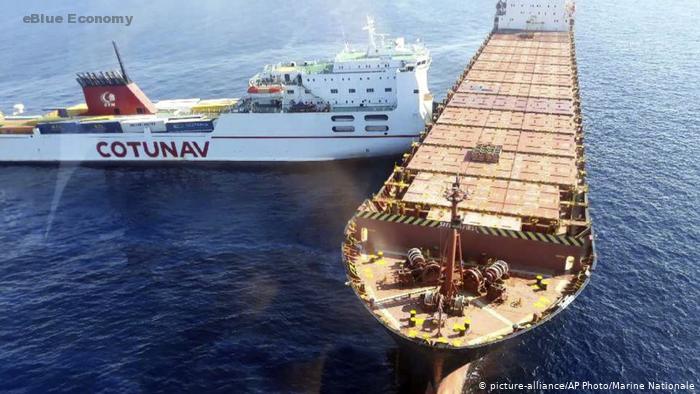
On 11 February 2015 a collision occurred between the claimant’s VLCC Alexandra 1 and the defendant’s 75,246 grt container vessel Ever Smart. The incident took place at night but in clear visibility within the pilot boarding area just outside the outer limit of a narrow channel leading to the port of Jebel Ali in the United Arab Emirates(the “channel”). Alexandra 1 was slowly approaching from the seawood along a rather irregular course waiting to pick up her pilot, while Ever Smart, was proceeding out of Jebel Ali on a steady course down the narrow channel at a much faster speed.
At the time of the collision the speed of Ever Smart was 12.4 knots, whereas the speed of Alexandra 1 was 2.4 knots. Alexandra 1 had Ever Smart on her starboard side, if the crossing rules applied, Alexandra 1 was therefore the give-way vessel. Despite the irregularities in Alexandra 1’s course and the changing speed of both vessels, the two ships remained on a steady compass bearing of each other for the whole of the 23-minutes period before the collision.
Rule 7 of the Collision Regulations and the reported decisions of the courts as well as the advice of the nautical assessors all made it clear that the approach of another vessel on a steady compass bearing is the surest sign that there is a risk of collision. The compass bearing of an approaching vessel may easily be measured by day or by night by radar or by the use of a compass.
The collision caused ships amounted to over US$35 million in damage to the two ships, prompting both parties to claim that the other was at fault.
Lower Courts judgment
The trail judge found that those navigating Ever Smart failed to keep a good visual lookout so that they only sighted Alexandra 1 at the last moment, while those navigating Alexandra 1 failed to keep a good audio lookout and therefore misinterpreted a radio message from the port control so that they thought wrongly that Ever Smart had been ordered to pass behind Alexandra 1’s stern. Both were therefore to blame for the collision. As a result, Ever Smart was deemed 80% liable for the damage caused by the collision and Alexandra 1 to be 20% liable.
The owner of Ever Smart had alleged that the crossing rules applied so that Alexandra 1 should have kept well clear of her. The judge decided that, although the two ships were crossing on a steady compass bearing and therefore with the risk of collision, nonetheless the crossing rules did not apply.
This was for two reasons: first, the Alexandra 1 was not on a steady course although Ever Smart was; second, the crossing rules were overridden by the narrow channel rule. The Court of Appeal agreed unanimously with the judge and dismissed Ever Smart owners’ appeal. It was satisfied that the navigation of Ever Smart was governed by the narrow channel rule and Alexandra I by Rule 2.
On their further appeal, the Supreme Court has decided unanimously that the crossing rules did apple to the encounter of the two ships, and therefore Alexandra 1 should have kept well clear of Ever Smart. Thus, the appeal is allowed.
The Decision of the Supreme Court
The two issues for the Supreme Court, sitting with two Nautical Assessors, to decide were:
-
1) The proper construction of the Collision Regulations. In particular whether the crossing rules were inapplicable, or whether they should be disapplied where an outbound vessel was navigating within a narrow channel and had a vessel on her port (or starboard) bow on a crossing course approaching the narrow channel with the intention of and in preparation for entering it.
-
2) On the proper construction of the Collision Regulations, in determining whether the crossing rules are applicable, whether there was a requirement for the putative give-way vessel to be on a steady course before the crossing rules can be engaged.