|
Getting your Trinity Audio player ready...
|
In the early hours of the morning, the quiet coastal city of Tuapse, on Russia’s Black Sea shore, was shaken by a series of explosions believed to be the result of a long-range Ukrainian drone strike. The attack targeted the Rosneft oil terminal, one of Russia’s key deepwater export facilities, igniting multiple fires and raising new concerns over the security of the country’s vital energy infrastructure.
Eyewitness Accounts and Visual Evidence
Video footage recorded at the time of the assault captured the distinctive hum of piston-engined drones, characteristic of Ukraine’s long-range UAV fleet. These drones have been extensively used by Kyiv in recent months to strike deep into Russian territory, primarily focusing on oil refineries and export terminals.
https://x.com/UaCoins/status/1985036569602826634
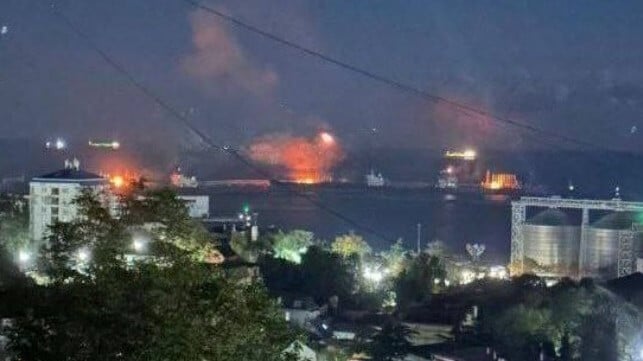
Images taken by bystanders from the harbor area show at least three separate fires burning on or near the terminal pier. Some appear to have originated aboard vessels moored at the dock, while others were concentrated on the pier infrastructure itself. Data from NASA’s FIRMS satellite fire detection system later confirmed a large infrared signature, visible from space, corresponding to the Tuapse terminal location — strong evidence of a major conflagration.
Further imagery taken after sunrise revealed tracer rounds and anti-aircraft fire streaking through the sky, suggesting that Russian air defense units were still engaging incoming drones long after the first explosions.
Damage and Environmental Impact
The Rosneft terminal at Tuapse is a strategically important installation, with an annual throughput capacity of roughly 50 million barrels. It can accommodate Aframax-class tankers — vessels up to 250 meters in length and 15 meters of draft — making it one of the few facilities on Russia’s southern coast capable of handling large-scale petroleum exports.
While the full extent of the damage remains uncertain, residents in the nearby town of Gizel-Dere, located about two miles south of the terminal, reported a significant oil slick spreading across the water. The sight of sheens of crude floating on the sea surface strongly suggests that the attack caused a breach in storage tanks or loading pipelines, marking one of the most environmentally consequential strikes on Russian territory since the start of the drone campaign.
https://x.com/wartranslated/status/1984990171969032673
Vessels Caught in the Strike
According to Anton Geraschenko, the former Ukrainian Deputy Minister of Internal Affairs, three tankers were moored at the terminal at the time of the attack. These included the Greek-owned Aframax “Pollux”, the product tanker “Coast Buster”, and the Turkish-owned tanker “Chai.” It remains unclear whether any of these vessels sustained critical damage, though footage and reports indicate that fires broke out in their immediate vicinity.
Broader Economic and Security Repercussions
Speaking to local Ukrainian media, Navy spokesman Dmytro Pletenchuk highlighted the strategic implications of the strike, saying:
“In addition to the direct damage to the technological chains involved in shipping, there will be a reaction among the companies that ship and fill up there. This includes an increase in insurance premiums and, in principle, will discourage many from entering these ports.”
The attack underscores the growing risks faced by commercial operators in the Black Sea and eastern Mediterranean regions. Rising insurance costs, combined with uncertainty about Russia’s air defense reliability, may push international shipping companies to reconsider routes and contracts involving Russian ports — particularly those handling oil exports.
A Pattern of Escalation
This marks the second Ukrainian strike on the Tuapse terminal in recent months. The previous attack, carried out in late September, reportedly involved a combined operation using both aerial and maritime drones. At least one suicide drone boat successfully penetrated Russian coastal defenses and struck a loading pier, though the scale of the resulting damage was never fully disclosed.
The repeated targeting of the facility indicates a deliberate strategy by Kyiv to degrade Russia’s oil export infrastructure, which plays a crucial role in funding Moscow’s war effort. By striking assets like Tuapse, Ukraine aims to disrupt logistics chains, increase operational costs, and create ripple effects throughout the energy export sector.
Looking Ahead
For Rosneft and the Russian authorities, the Tuapse attack poses a serious operational challenge. Even temporary interruptions in terminal operations can delay shipments, disrupt refinery output, and force rerouting of exports to alternative ports — each carrying significant logistical and financial implications.
The incident also serves as a stark reminder that Ukraine’s drone capabilities are not only expanding in range but also in precision and coordination. As the conflict continues to evolve, such strategic deep strikes are likely to remain a central feature of Kyiv’s asymmetric warfare approach — one that seeks to outmaneuver Russia’s conventional strength through targeted technological innovation.
In the aftermath, questions linger about how soon operations at Tuapse can resume, and whether future attacks will further expose the vulnerability of Russia’s energy arteries. What is certain, however, is that the battle over infrastructure has become as critical to the war’s trajectory as the battles fought on the front lines.