|
Getting your Trinity Audio player ready...
|
The National Transportation Safety Board (NTSB) announced Tuesday that a veteran towboat pilot’s incorrect anticipation of a strong cross-current was the key factor behind a costly collision involving the Fort Madison Bridge on the Mississippi River.
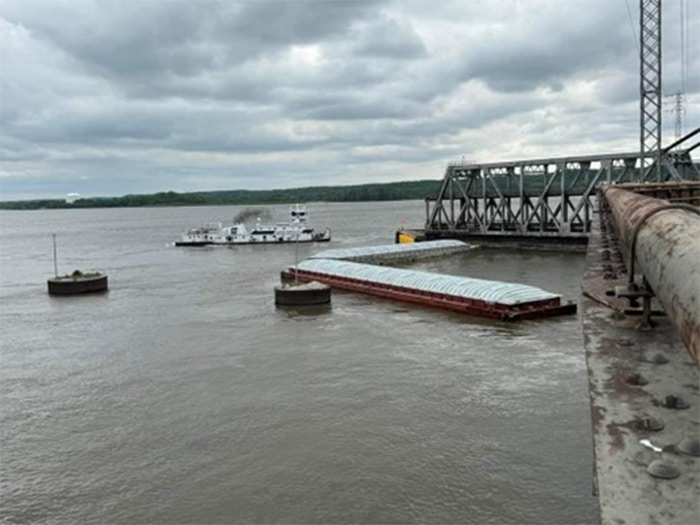
On May 9, 2024, the 158-foot towboat Joe B. Wyatt, built in 1982 and operated by Ingram Barge Company, was navigating downriver near Fort Madison, Iowa. The vessel was pushing a tow consisting of 13 fully loaded hopper barges and two empty tank barges when it collided with parts of the bridge’s protection cell and fendering system. The impact caused the tow to break apart. Fortunately, there were no injuries or environmental hazards reported. The total damage was estimated at $3.28 million, affecting the bridge structure, the barges, and the towboat itself.
According to the NTSB report, the pilot—who had decades of experience steering tows through the Fort Madison Bridge’s main channel—adjusted his course based on an expected cross-current he believed would come from around Dutchman Island. Relying on his prior experience, he shifted the tow over 200 feet away from the designated sailing line, aiming toward the right descending bank of the river. However, the anticipated cross-current did not materialize as expected, leaving the tow out of alignment as it neared the bridge.
In an attempt to correct the course, the pilot increased engine power to move the head of the tow back toward the center of the channel. Despite these efforts, the third barge in the starboard string struck the bridge’s protection cell. The collision caused the tow to split apart, with 13 of the 15 barges drifting uncontrolled downriver.
“Sailing lines are designated safe paths for commercial vessels, developed with consideration for channel depth, current behavior, and potential navigation hazards,” the NTSB report stated. “They serve as reliable guides for safe passage, especially when combined with the mariner’s judgment and evaluation of real-time conditions.”
The incident highlights the critical role of adhering to charted sailing lines and the importance of balancing experience with actual situational data.